An AI marketing agency vs in-house team cost comparison shows agencies win on budget. Hiring a full internal staff triggers massive overhead—salaries, benefits, and soaring software costs. An external agency absorbs those heavy AI infrastructure expenses across multiple clients, giving you instant enterprise-level tech and expert execution for a fraction of the cost.
For most startups and growing brands in 2026, working with an AI marketing agency costs 40–65% less than building an equivalent in-house marketing team — once you factor in salaries, benefits, tools, and management overhead. But cheaper isn’t always better. This guide breaks down AI marketing agency vs in-house team comparison, every number, every hidden cost, and every scenario so you can make the right call for your stage.
Table of Contents
Understanding the Two Models
Cost Breakdown: AI Agency vs In-House Team
Which Option Actually Saves More Money?
ROI Comparison
The Hidden Costs Most Businesses Ignore
The Rise of Hybrid AI Marketing Models
Best Choice Based on Business Stage
Future of Marketing Teams in the AI Era
Final Decision Framework
Is Hiring an AI Marketing Agency Cheaper Than Building an In-House Team in 2026?
Yes — for most companies under $10M ARR, the cost comparison between in-house AI SEO teams and agencies falls decisively in the agency’s favor. Outsourcing to an AI-powered agency costs significantly less than hiring even a minimal in-house marketing team, especially when total employment costs (benefits, tools, management time) are calculated honestly.
The math has shifted dramatically in 2026. AI automation now allows a four-person agency team to deliver the output that previously required 12–15 in-house specialists. That leverage is what makes the cost equation so lopsided — and why more founders are re-examining every headcount assumption they’ve made about marketing. Whether you’re debating in-house AI vs agencies or weighing digital marketing outsourcing vs in-house teams, the structural economics of this decision look fundamentally different than they did even two years ago.
Understanding the Two Models
What Is an AI Marketing Agency?
An AI marketing agency is an external partner that combines strategic oversight with AI-powered execution — running campaigns, content, SEO, and paid media through automation-first systems rather than manual headcount. It’s company-run marketing’s opposite: everything is external, systematized, and leveraged.
Modern AI agencies don’t just use ChatGPT to write blog posts. They operate integrated stacks — AI content engines, programmatic SEO pipelines, automated A/B testing frameworks, and predictive ad optimization tools — all managed by a lean team of senior strategists. You get the output of a 10-person department for the cost of a retainer. For growing brands that need velocity without overhead, this is the fundamental value proposition of an artificial intelligence SEO agency vs an in-house department. Think of it as renting a fully built marketing machine rather than constructing one from scratch.
What AI agencies typically deliver:
AI-powered content at scale (SEO articles, ad copy, email sequences)
Automated campaign management across Google, Meta, and LinkedIn
Data-driven strategy powered by real-time analytics
Monthly reporting and growth optimization
Fractional CMO-level strategic input
What Counts as an In-House Marketing Team?
An in-house marketing team means full-time employees on payroll — people who show up every day, learn your brand deeply, and build internal marketing operations from the ground up. It’s what most founders default to when they think “hiring a marketing team.”
This model made complete sense when human execution was the only option. Today, the case for building an in-house marketing team vs using an AI marketing agency is narrower: deep brand complexity, regulated industries, long-term consistency at scale, or organizations where institutional knowledge is a genuine competitive moat. Most early-stage companies build in-house teams out of control instinct, not financial logic. They want ownership. They get overhead.
Typical in-house team for a mid-market brand:
Content Strategist / SEO Specialist
Paid Media Manager
Social Media Manager
Designer / Video Editor
Marketing Operations / CRM Manager
Head of Marketing / VP Marketing
Why This Decision Matters More in 2026
AI has fundamentally changed the economics of marketing execution. Tasks that required 6 specialists in 2022 require 1–2 people with the right AI stack today — and this shift is the central reason the in-house marketing vs agency debate has intensified.
Labor costs have surged simultaneously. A senior marketing hire in the US or UK now carries a fully-loaded employment cost (salary + benefits + equity + tools) of $120,000–$180,000 per year for mid-level roles. Meanwhile, AI agency retainers for equivalent output range from $4,000–$15,000/month. The gap between “what you pay for headcount” and “what you get from headcount” has never been wider — which is exactly why founders who built in-house teams in 2021 are now restructuring toward leaner, AI-powered marketing agency vs internal staff models. Scaling expectations have also compressed: what used to be a 12-month channel-build is now expected in 90 days.
Cost Breakdown: AI Agency vs In-House Team
What Are the Real Costs of an In-House Marketing Team vs an AI Agency?
In the cost comparison between an in-house marketing team and an AI agency, an in-house team of 5–6 people costs $600,000–$900,000+ per year in the US when fully loaded. A comparable AI agency engagement runs $60,000–$180,000 annually. The gap is real — and most businesses dramatically underestimate the true cost of hiring in-house.
Upfront Hiring Costs
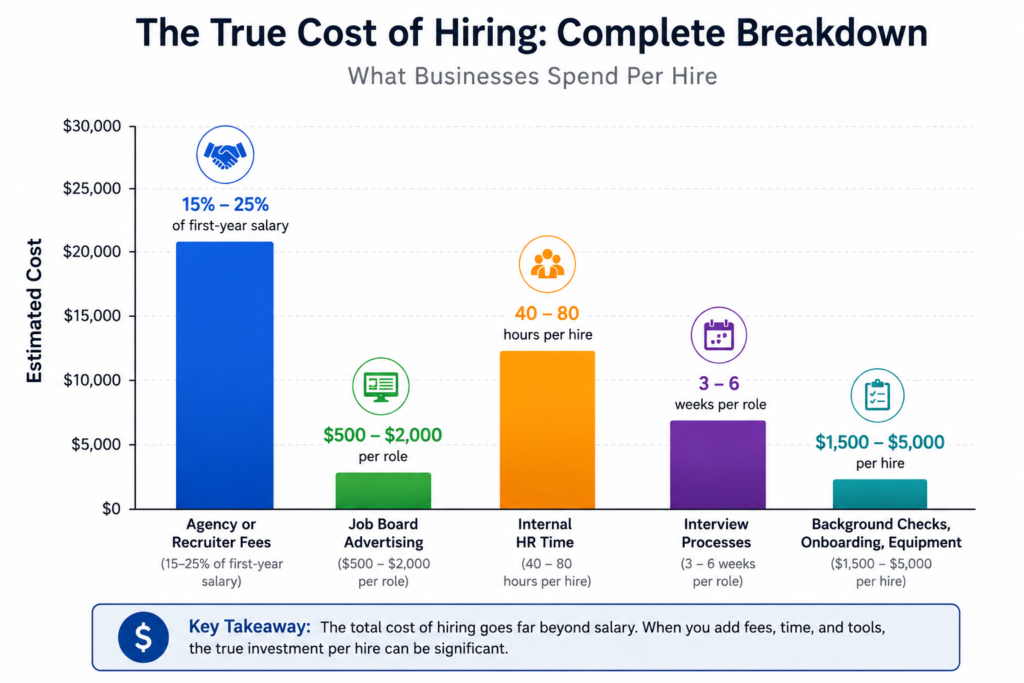
Before a single campaign goes live, hiring an in-house team costs you $15,000–$40,000+ in recruitment alone — and that’s before anyone is productive. This is the first place the cost comparison marketing team calculations go wrong for founders who only look at salary lines.
Recruitment cost breakdown per hire:
Agency or recruiter fees: 15–25% of first-year salary
For a 5-person team, you’re looking at $75,000–$200,000 in upfront recruitment costs before factoring in the 30–90 day ramp time before new hires become fully productive. When you outsource marketing vs hire employees, an AI agency is typically operational within 2–4 weeks — with no recruitment costs, no ramp period, and no risk of a bad hire.
Salary Costs of In-House Marketing Teams (USA & UK)
Salaries alone tell a sobering story about startup marketing team costs in both the USA and UK. Here’s what a functional in-house marketing team actually costs in 2026 — before benefits, taxes, or tools.
US Salary Benchmarks (2026):
Role
US Annual Salary
UK Annual Salary
SEO Specialist
$65,000 – $95,000
£38,000 – £58,000
Paid Ads Manager
$70,000 – $110,000
£42,000 – £65,000
Content Strategist
$60,000 – $90,000
£35,000 – £55,000
Designer / Editor
$55,000 – $85,000
£32,000 – £50,000
Marketing Ops / CRM
$75,000 – $115,000
£45,000 – £68,000
Head of Marketing
$120,000 – $180,000
£70,000 – £110,000
TOTAL (mid-range)
~$595,000/year
~£360,000/year
Add employer-side costs (national insurance, pension, health benefits, PTO liability) and multiply by 1.25–1.35. Your true employment cost for this team in the US: $745,000–$800,000/year. In the UK: £450,000–£490,000/year.
Marketing salary inflation has run at 6–9% annually since 2022, driven by AI skill premiums and a compressed talent market for performance marketers who understand automation. This is one reason more companies are evaluating the ROI of hiring a marketing agency vs an in-house team — the cost of in-house talent keeps rising while agency pricing has remained relatively stable as AI reduces agencies’ own operational costs.
AI Marketing Agency Pricing Models
Most AI agencies price between $3,000–$20,000/month on retainer, with performance tiers. This range covers vastly different service levels — here’s how to read it.
Common pricing structures:
Monthly Retainer ($3,000–$8,000/month): Best for startups and early-growth companies. Covers content, SEO, and light paid media management. Equivalent to 1–2 in-house employees — but with 3–4× the output due to automation leverage.
Mid-Market Retainer ($8,000–$15,000/month): Full-service execution — content at scale, paid media management, email automation, analytics reporting, and monthly strategy. Equivalent to a 4–5 person in-house marketing department at a fraction of the fully-loaded employment cost.
Performance-Based Pricing: The agency earns a base retainer plus a percentage of revenue driven (typically 10–20% of ad spend, or a revenue share). Aligns incentives, but requires rigorous attribution infrastructure.
Hybrid Pricing: Base retainer for strategy plus performance fees for execution. Increasingly common in 2026 as AI makes campaign output more measurable and attributable.
Software & AI Tool Expenses
In-house teams need a full tool stack — and those costs compound fast. This is where the efficiency of an AI SEO agency vs an internal team becomes especially visible: agencies have already absorbed these costs across their client base.
Typical in-house marketing tool stack (annual):
Category
Tools
Annual Cost
AI Content
Jasper, Copy.ai, Surfer SEO
$3,600 – $9,600
SEO Platform
Ahrefs, SEMrush
$2,400 – $4,800
CRM
HubSpot, Salesforce
$6,000 – $24,000
Email Automation
Klaviyo, ActiveCampaign
$2,400 – $7,200
Analytics
GA4 + Hotjar + Databox
$2,400 – $6,000
Design
Adobe Creative Cloud, Figma
$1,800 – $4,800
Paid Media Mgmt
Optmyzr, Motion
$3,600 – $9,600
Project Management
Notion, Asana
$1,200 – $3,600
TOTAL
$23,400 – $69,600/year
AI agencies own this stack already. You’re not paying for it separately — it’s baked into the retainer. This represents $20,000–$70,000 in annual savings for early-stage companies choosing digital marketing outsourcing vs building an in-house team — before a single strategy meeting has happened.
Operational Overhead Costs
Headcount creates invisible costs that don’t appear on any salary spreadsheet. These are the costs that quietly destroy the ROI of in-house marketing teams — and the ones most founders completely ignore when they make the hiring vs agency comparison.
Every employee requires management time. A marketing team of 6 typically requires 8–12 hours per week of founder or executive oversight for stand-ups, reviews, hiring decisions, performance management, and strategic alignment. At $250–$500/hour opportunity cost for a founder or CEO, that’s $100,000–$250,000 annually in management overhead that never appears on the P&L.
Additional hidden overhead: office space allocation ($12,000–$24,000/person/year in major markets), HR software, payroll processing, compliance costs, and the compounding cost of coordination inefficiency — meetings, approval chains, and communication overhead that scales non-linearly with team size. When you’re evaluating hiring a marketing agency vs doing it in-house, this line item alone can shift the entire analysis.
Time Cost & Speed-to-Execution
Speed is money. An AI marketing agency can launch a campaign in days. An in-house team needs weeks — sometimes months. This execution gap is one of the most decisive but least quantified factors in the in-house vs marketing agency debate.
AI agencies bring pre-built workflows, established vendor relationships, proven campaign frameworks, and automation infrastructure that took years to build. When you hire in-house, you’re paying people to build all of that from scratch — while competitors who’ve already solved these problems move faster. For a campaign that should launch in Week 2 but launches in Week 8 due to in-house process development, the opportunity cost is measurable. And it often exceeds the salary savings you thought you were making.
Which Option Actually Saves More Money?
Pros and Cons of In-House Marketing vs Agency: The Real Cost Picture
The clear winner for most growth-stage companies: An AI marketing agency or hybrid model — by a significant margin. But the decision has real nuance depending on your stage, your brand complexity, and your scaling trajectory.
When AI Agencies Save More Money ?
AI-powered marketing agencies deliver superior economics in three scenarios: when you’re early-stage, when speed matters more than brand depth, and when your marketing needs fluctuate with business cycles.
Specifically, choose an AI agency when:
You’re pre-Series A or under $5M ARR and every dollar is scrutinized
You need to test multiple channels simultaneously without committing to headcount
Your industry has high execution volume (content, ads, email) but moderate strategic complexity
You’re entering a new market or launching a product line and need velocity
Your marketing needs scale up and down seasonally
You don’t yet have a clear picture of which channels drive your best customers
The scalability of in-house AI vs agency solutions also diverges here. Agencies scale instantly; in-house teams require rehiring cycles. At these stages, the ability to flex up or down, access senior expertise without committing to senior salaries, and launch immediately without ramp time makes an AI agency demonstrably cheaper, faster, and lower risk than building internal marketing operations from scratch.
When In-House Teams Become More Cost-Effective
In-house wins when scale is high enough, brand complexity is real, and the operational overhead of agency management outweighs its cost benefits. This is genuine — and it’s important not to oversimplify the agency-vs-in-house debate.
In-house becomes the right call when:
You’re generating $20M+ ARR and marketing is a primary growth driver
Your brand has exceptional nuance requiring deep institutional knowledge (luxury, healthcare, legal)
You’re running 500+ campaigns simultaneously and need real-time, on-brand decision-making
You’ve validated channels and now need optimization depth, not new channel testing
Regulatory requirements demand full ownership of all communications and data
At enterprise scale, the ROI of hiring a marketing agency vs an in-house team often flips. A 15-person in-house team running $10M+ in annual ad spend may produce better ROI per dollar than an agency that can’t be as responsive or embedded in your data environment.
Why Many Companies Overspend on In-House Teams
Most companies that build large in-house marketing departments do so too early — driven by control instinct rather than financial logic. This is one of the most expensive and common mistakes in growth-stage marketing.
The most common overspend patterns: hiring a Head of Marketing at $150,000+/year before you’ve validated your ICP; building a content team before your distribution is proven; hiring specialists for channels you haven’t tested. The result is talented people who are underutilized, spending 40% of their time in internal meetings, producing output that a well-run AI marketing agency vs internal staff model could replicate at a third of the cost. Tool duplication is also rampant — paying for three analytics platforms, two CRMs, and overlapping AI writing tools is shockingly common in in-house marketing departments.
Why Some Businesses Overpay Agencies
Bad agency relationships are real and expensive. The warning signs are usually visible from the first proposal — and knowing them is essential to making the hiring a marketing agency vs doing it in-house decision correctly.
You’re overpaying when: reporting is activity-based rather than outcome-based (counting blog posts, not pipeline); the agency uses the same content templates across every client; they can’t articulate how their AI tools are integrated into the work; they resist transparent attribution; or their “AI-powered” offer is really just junior staff using ChatGPT with no strategic layer. The fix: demand outcome-based KPIs in every contract, require channel-level attribution reporting, and insist on monthly strategy calls with a senior strategist — not an account manager.
ROI Comparison: In-house marketing vs agency
Which Delivers Better ROI: AI Marketing Agencies or Internal Teams?
AI agencies typically deliver 2–4× higher ROI per dollar in the startup and growth stages. At enterprise scale, in-house teams often catch up — but the breakeven point is later than most founders assume.
Efficiency & Output Comparison
The key ROI driver in 2026 isn’t strategy — it’s execution velocity multiplied by AI leverage. Agencies have this. Most in-house teams are still building it.
A well-run AI agency can publish 40–80 SEO-optimized articles per month, manage $500K+ in paid media across platforms, run 20+ A/B tests simultaneously, and generate full email sequences — because their infrastructure is already built. An in-house team of equivalent size would spend 30–40% of their time on process, tooling, and coordination rather than execution. That’s not a team failure; it’s a structural reality of building systems from scratch.
Scalability Comparison
Agencies scale faster in the short term. In-house scales better in the long term — but only after significant infrastructure investment.
An AI agency can double your content output or ad spend management in 30 days without a new hire. In-house scaling means recruiting (6–12 weeks), onboarding (4–8 weeks), and process adaptation (ongoing). For fast-growing companies, this lag compounds — every quarter you’re rebuilding the team for the next growth stage instead of executing at the current one. By the time your in-house team has fully scaled to match an agency’s output infrastructure, you’ve spent 18–24 months and several hundred thousand dollars in transition costs.
Innovation & Adaptability
Platform algorithms change monthly. AI tools evolve weekly. Agencies that work across 20+ clients adapt faster than internal teams focused on a single brand.
When Google’s algorithm shifts, Meta’s ad auction changes, or a new AI content tool halves production costs, agencies see it across their entire client portfolio and adapt immediately. Internal teams often lack the cross-client signal to recognize platform trends early — and their change management process slows adaptation further. In 2024–2025 alone, AI agencies navigated GPT-4o launches, Google’s HCU algorithm updates, and Meta’s AI ad tool rollouts significantly faster than most in-house teams.
Brand Understanding & Alignment
This is where in-house teams genuinely win. Brand depth takes time, and agencies start from zero.
An employee who’s been with your brand for two years understands your voice, your customer psychology, your competitive nuances, and your founder’s vision in ways that no agency brief can fully capture. This matters most in categories where brand differentiation is the primary competitive moat: luxury goods, consumer culture brands, mission-driven companies. The agency onboarding process (typically 4–8 weeks) covers the basics — but genuine brand fluency takes 6–12 months to develop. For many businesses, this gap never fully closes.
The Hidden Costs Most Businesses Ignore
Employee Turnover Costs
Marketing has one of the highest turnover rates of any business function — averaging 30–35% annually. Every departure is a cost event that rarely appears in budget forecasts.
When a senior marketing hire leaves, the fully-loaded replacement cost is typically 50–200% of their annual salary: recruiter fees ($15,000–$30,000), internal hiring time (40–80 hours), onboarding ($3,000–$8,000), productivity ramp (3–6 months), and the institutional knowledge that leaves with them. A content strategist who built your SEO structure takes that knowledge with them. An agency, by contrast, maintains institutional knowledge in documented systems — and turnover in an agency’s team doesn’t crater your campaign continuity.
AI Tool Mismanagement
In-house teams frequently pay for AI tools they don’t fully use — a hidden cost that’s accelerating as the AI tool market expands.
The average mid-market marketing team in 2026 subscribes to 12–18 software tools. Research suggests 35–45% of those subscriptions are underutilized — tools bought during a demo high, integrated poorly, and left running on autopilot. The annual cost of tool waste for a 5-person team: $8,000–$25,000. Agencies, which live or die by tool efficiency, have ruthlessly optimized their stacks — and the cost is distributed across multiple clients, making per-client tool costs a fraction of what an in-house team pays independently.
Management Bottlenecks
Every person you hire is a management obligation. For founders and CEOs, this is often the most undervalued cost of building in-house.
Marketing teams require constant creative direction, strategic calibration, performance review, and interpersonal management. For a founder managing a 6-person marketing team alongside product, sales, and investor relations, the cognitive overhead is enormous. Studies consistently show that high-growth founders who outsource marketing operations have more available bandwidth for product and sales decisions — the areas where founder involvement has the highest leverage. An agency acts as a self-managing unit that requires 2–4 hours of executive input monthly, not 10–15.
Slow Execution Costs
Delayed campaigns have a cost that’s rarely quantified — but should be.
Every week a campaign sits in internal review, revision, or approval chains is a week of potential customer acquisition you’re not capturing. For a company with a $50 CPA and 500 potential conversions per month, a 4-week delay in launching a new paid channel costs $25,000 in revenue. Multiply that across a year of delayed campaigns, slow content publication, and missed trend windows — and slow execution costs most mid-market companies $100,000–$500,000 annually in foregone revenue. Agencies, with pre-built approval structures and dedicated account managers, execute significantly faster.
The Rise of Hybrid AI Marketing Models
What Is the Best Hybrid Model for AI-Driven Marketing in 2026?
The answer most sophisticated growth teams are landing on: A small internal strategy layer (1–2 people) combined with an AI agency for execution — giving you brand depth and operational velocity at a fraction of full in-house cost.
Small Internal Team + AI Agency Support
The 2026 growth playbook for companies between $3M–$20M ARR: one internal Head of Marketing as a strategic anchor, with an AI agency handling all execution.
This model captures the best of both worlds: your internal head of marketing owns brand positioning, executive alignment, customer insight, and channel strategy. The agency owns execution — content production, paid media management, SEO, email, and analytics. Total cost: $180,000–$240,000 (internal head) + $96,000–$180,000 (agency retainer) = $276,000–$420,000/year. Compare to a full in-house team at $745,000–$900,000/year for equivalent output. The savings — $300,000–$480,000 annually — compound directly into growth capital.
AI as Infrastructure, Humans as Strategists
The defining shift of 2026: AI handles the execution layer; humans own the judgment layer. Companies that reverse this (humans executing, AI strategizing) underperform.
Execution tasks — writing first drafts, scaling ad variations, publishing content, reporting on metrics — are AI’s domain. Positioning decisions, brand voice calibration, partnership strategy, creative direction, and customer psychology are human domains. Organizations that have restructured around this principle are running marketing operations with 60–70% fewer people than their 2021 equivalents while producing equal or greater output. The productivity gains from AI-assisted marketing workflows are real: content production speed up 400–600%, campaign testing cycles compressed from months to weeks.
Fractional Marketing Teams Becoming Common
The fractional model — senior specialists engaged part-time rather than full-time — has exploded in 2026 and represents a third path between agency and full in-house.
A fractional CMO ($5,000–$15,000/month) combined with an AI agency for execution often outperforms a full in-house team for companies in the $5M–$25M range. You get genuine senior strategic expertise without the full-time commitment — and the fractional executive typically brings proven playbooks and agency relationships that compress time-to-impact significantly. Expect fractional marketing to become the default model for Series A and B companies that want strategic depth without the $200,000+ CMO salary.
Best Choice Based on Business Stage
When Should Startups Outsource Marketing Instead of Hiring Employees?
Startup Stage (Pre-revenue to $5M ARR): Outsource almost everything. Your job is to find product-market fit and validate channels — not to build a marketing department.
At the startup stage, an AI agency gives you expert execution across multiple channels simultaneously without committing to headcount that outlasts your runway. You can test SEO, paid, email, and content at the same time, find what works, then double down — all while keeping burn manageable. The moment you hire a specialist before you’ve validated their channel, you’ve made an expensive bet on an unproven hypothesis. Most agencies will work on 3–6 month engagements, giving you an exit if a channel doesn’t prove out. Headcount has no equivalent flexibility.
Recommended model: AI agency ($4,000–$8,000/month) + founder-led brand direction.
Growth Stage ($5M–$20M ARR)
At the growth stage, you’ve validated 1–2 channels. Now it’s about scaling execution while adding strategic depth — the hybrid model wins here.
You know your ICP. Again, you are aware of your best-performing channels. You know your messaging. Now you need to scale what’s working without losing the brand integrity that made it work. This is the moment to bring in one internal head of marketing who deeply understands your brand, while keeping an AI agency running the execution layer. Adding headcount before this validation leads to expensive pivots; waiting too long after it means leaving growth on the table.
Recommended model: 1 internal Head of Marketing + AI agency retainer ($8,000–$15,000/month).
Enterprise Stage ($20M+ ARR)
At enterprise scale, the economics of in-house teams improve significantly — but the transition requires careful planning.
When marketing is generating $5M–$20M+ in attributable pipeline annually, the ROI per in-house employee improves dramatically. Internal teams at this stage have enough volume to justify specialization, enough brand complexity to benefit from institutional knowledge, and enough budget to build a world-class tool stack. The shift to in-house also gives enterprise brands full control over data, brand safety, and channel strategy — increasingly important as AI-generated content regulations evolve.
Recommended model: Full in-house team (10–20 people) with agency support for specialist overflow or new market entry.
Future of Mr the Next 5 Years?
AI won’t eliminate marketing jobs — it will compress team sizes dramatically while raising the value of each remaining role. The 20-person marketing department of 2021 becomes the 4-person marketing department of 2027.
AI Will Reduce Team Sizes
The evidence is already clear: companies that have adopted AI-first marketing workflows are running leaner teams with higher output than their pre-AI equivalents.
Research from multiple growth-stage companies in 2024–2025 shows that AI tool adoption reduced marketing headcount needs by 35–60% — without reducing campaign volume. Content teams that required 8 writers now require 2, who use AI to scale production while maintaining quality oversight. Paid media teams that required 4 specialists now require 1–2, using AI optimization platforms to manage complexity that previously required human analysts. This isn’t future speculation — it’s the current state at companies that have actually built AI-first operations.
Marketing Roles Will Shift Toward Strategy
The execution layer of marketing is becoming automated. The strategic, judgment, and creativity layers are becoming more valuable — and more human.
AI can write a blog post. It can’t decide which narrative wins in a competitive market. AI can optimize bids. It can’t develop a brand positioning that resonates emotionally with a specific customer segment. AI can A/B test headlines. It can’t synthesize customer interviews into a messaging framework that shifts perception. The marketers who will command premium compensation in 2026 and beyond are those who use AI tools fluently while maintaining high-level strategic and creative judgment — the layer AI consistently underperforms on.
Agencies Will Become AI System Operators
The agency of 2026 isn’t a service provider — it’s a growth infrastructure partner. The ones that survive the AI transition are building proprietary systems, not just using public tools.
The best AI marketing agencies are developing custom automation workflows, proprietary training data for AI models, integrated attribution platforms, and systematic testing frameworks that constitute real IP. When you hire one of these agencies, you’re not buying hours — you’re accessing infrastructure. This shift mirrors what happened in software: the value moved from code written to systems built. For clients, the implication is clear: evaluate agencies on their systems and outcomes, not their team size or deliverable lists.
Final Decision Framework
What Marketing Model Scales Faster for Startups and Growing Brands?
Use this framework to make the right call for your specific situation — not the consensus answer for your stage.
Choose Based on Speed, Budget, and Complexity
→ Speed is your primary constraint: Choose an AI agency. Pre-built systems, zero ramp time, immediate execution. Campaigns live in weeks, not quarters.
→ Brand depth is your primary constraint: Lean toward in-house or hybrid. If your brand voice is your competitive moat, invest in people who can live inside it.
→ Flexibility is your primary constraint: Choose an AI agency or fractional model. Headcount is a fixed cost; agency retainers flex with your needs.
→ Budget is your primary constraint: Choose an AI agency, almost without exception. At comparable quality levels, agencies cost 40–65% less than equivalent in-house teams for companies under $20M ARR.
Focus on ROI Per Dollar, Not Just Monthly Cost
The most dangerous mistake in this decision is comparing a $12,000/month agency retainer to a $12,000/month salary and concluding they cost the same.
The salary costs $12,000/month. The total employment cost (benefits, taxes, tools, management overhead, office space) costs $18,000–$22,000/month. The agency costs $12,000/month. But the agency delivers the output of 3–5 employees. The real comparison: $18,000–$22,000/month for one person’s output, or $12,000/month for a team’s output. Measured correctly, the ROI per dollar for AI agencies at the growth stage is not marginally better — it’s structurally different. Make the decision with the right math, not the simplified version.
Real Monthly Cost Example: $10M ARR SaaS Company
In-House Model:
1 Head of Marketing: $16,500/month loaded
1 SEO Specialist: $8,300/month loaded
1 Paid Ads Manager: $8,750/month loaded
1 Content Strategist: $7,900/month loaded
1 Designer: $7,000/month loaded
Tool stack: $4,000/month
Total: ~$52,450/month ($629,400/year)
AI Agency Model:
AI agency retainer (full-service): $12,000/month
1 internal Head of Marketing: $16,500/month loaded
Fractional creative support: $2,500/month
Total: ~$31,000/month ($372,000/year)
Annual savings with hybrid model: ~$257,400 — capital that compounds directly into growth.
Biggest Myths About AI Marketing Agencies
Myth 1: “Agency work is generic — they use the same playbook for everyone.” Reality: The best AI agencies build client-specific systems. The generic criticism applies to bad agencies, not the category.
Myth 2: “I’ll lose control of my brand.” Reality: With proper onboarding, brand guidelines, and approval workflows, agencies can maintain voice consistency as well as in-house teams — and often better, because they’re more process-disciplined.
Myth 3: “AI-generated content will hurt my SEO.” Reality: Google’s 2024–2025 algorithm updates penalize low-quality content, not AI-assisted content. Well-structured, expert-reviewed, AI-assisted content outperforms manually-written content that lacks SEO infrastructure.
Myth 4: “Once I build in-house, I’ll never go back.” Reality: Many enterprise brands are moving back to hybrid and agency models as AI makes execution cheaper than headcount.
Summary: The Decision Matrix
Factor
Startup
Growth
Enterprise
Best model
AI Agency
Hybrid
In-House + Agency support
Monthly cost range
$4K–$8K
$25K–$40K
$50K–$150K+
Speed to execution
Fast
Moderate
Slow
Brand alignment
Lower initially
Medium
High
Scalability
High
High
Moderate
Risk level
Low
Low-Medium
Medium
ROI per dollar
⭐⭐⭐⭐⭐
⭐⭐⭐⭐
⭐⭐⭐
Frequently Asked Questions
For most startups and growth-stage companies: yes, for execution. No, for strategic brand leadership. The best model combines external AI execution with internal strategic ownership.
Expect $3,000–$8,000/month for startup-level services, $8,000–$15,000/month for growth-stage full-service, and $15,000–$30,000/month for enterprise-level campaigns.
Ask them to walk you through their content production workflow, their ad optimization process, and their SEO execution system. AI-powered agencies have documented, scalable, repeatable workflows. Traditional agencies with a bolt-on “AI layer” don’t.
When you’re consistently generating $20M+ ARR, your brand complexity genuinely requires institutional knowledge, and you’re running marketing programs at a scale where in-house specialization delivers measurably better unit economics than agency leverage.
Author Bio
Purvansh Infotechis a next-generation AI digital marketing agency helping brands scale faster with data-driven strategies, automation, and performance intelligence. Purvansh Infotech is an AI-driven digital marketing agency built to help ambitious brands scale faster, smarter, and more profitably. We combine artificial intelligence, performance marketing expertise, and data-led strategy to turn digital activity into measurable revenue growth.