AI in digital marketing is completely reshaping how businesses engage customers. By shifting to automated data analysis and hyper-personalization, AI digital marketing services allow you to predict consumer behavior, automate campaign optimization, and scale content instantly. Adapting to how AI is changing digital marketing services isn’t optional anymore—it’s an urgent requirement to avoid being left behind.
AI in digital marketing is not a future trend anymore. It’s our present reality that is already changing how the digital marketing works. The zero click era has arrived and now those businesses will win who are actively implementing the new mechanisms. The inflection point arrived quietly — through algorithm updates, through new tools quietly embedded in platforms you already use, through competitors whose campaigns suddenly got smarter, faster, and more efficient than yours.
The numbers are stark. Businesses that have integrated AI in digital marketing operations report 40–60% reductions in cost per acquisition, 30–50% improvements in content production efficiency, and conversion rate increases of 25–35% driven by personalization at scale. These are not projections from technology vendors with an agenda — they are documented outcomes from organizations that moved early and moved strategically.
The AI digital marketing services landscape is evolving faster than any previous marketing technology shift. The businesses that understand and act on this shift now will build competitive positions that become increasingly difficult to displace. The businesses that wait will find that the gap has grown too large to close affordably. This is the guide that tells you exactly what is happening, why it matters, and what to do about it — starting today.
| 📌 What This Guide Covers: The complete landscape of AI in digital marketing across every major channel, the specific AI tools and capabilities driving measurable ROI, how to evaluate AI-powered marketing agencies and services, the strategic framework for integrating AI into your marketing operations, and a practical implementation roadmap for businesses at every stage. |
The AI Marketing Revolution — What Is Actually Changing and Why It Matters
To understand AI in digital marketing properly, you need to distinguish between the signal and the noise. The AI marketing space is flooded with hyperbole — tools claiming to replace entire marketing teams, platforms promising to automate everything, vendors asserting their AI is the only AI that matters. Cutting through this requires a clear understanding of what AI is actually doing in marketing operations today versus what remains aspirational.
What AI in Digital Marketing Is — and Is Not
At its core, AI in digital marketing encompasses four distinct capabilities that are reshaping how marketing operates:
- Pattern recognition and prediction: AI systems analyze massive datasets to identify patterns in customer behavior, market trends, and campaign performance that human analysts cannot detect at speed or scale. This underpins everything from predictive bidding in Google Ads to churn prediction in CRM systems.
- Natural language generation and understanding: Large language models (LLMs) like the technology powering tools such as ChatGPT, Claude, and Gemini generate, edit, and optimize written content at scale — while also enabling systems to understand and categorize customer intent from search queries, emails, and social interactions.
- Visual and creative intelligence: AI-powered creative tools generate imagery, video, and ad creative variations at scale — enabling A/B testing at volumes previously impossible without large creative teams and significant production budgets.
- Decision automation: AI systems make real-time bidding decisions, trigger personalized content delivery, route leads to appropriate sales sequences, and adjust campaign parameters continuously — without human intervention for each individual decision.
What AI in digital marketing is NOT — at least not yet — is a full replacement for strategic human judgment. AI optimizes within defined parameters. It executes strategies it has been configured to pursue. The businesses that are winning with AI are those that combine the pattern-recognition and execution speed of AI with the strategic clarity and creative instinct of experienced human marketers. AI amplifies marketing talent — it does not replace it.
The Scale of Transformation: What the Data Shows
| Marketing Function | Before AI | With AI Integration | Performance Gain |
| Content production | 4–8 hrs per piece | 1–2 hrs per piece (with AI assist) | 60–75% faster |
| PPC bid management | Manual weekly adjustments | Real-time automated optimization | 20–40% lower CPA |
| Email personalization | Segment-based (5–10 variants) | Individual-level (thousands of variants) | 30–50% higher CTR |
| Lead scoring | Rule-based manual scoring | Predictive behavioral scoring | 40–60% better SQL rate |
| Customer segmentation | Demographic/firmographic only | Behavioral + predictive micro-segments | 25–35% higher conversion |
| Ad creative testing | 2–4 variants tested monthly | Hundreds of variants tested continuously | 15–30% higher ROAS |
| Content SEO optimization | Manual keyword placement | AI semantic optimization + intent matching | 35–55% more organic traffic |
| Customer service response | Hours to days | Seconds (AI chatbots) | 85%+ faster resolution |
These performance improvements are not theoretical benchmarks from controlled conditions. They reflect documented results from organizations that have systematically integrated AI in digital marketing operations. The gains are real, they are compounding, and they are creating performance gaps between AI-integrated and non-AI businesses that widen every quarter.
| ⚡ The Competitive Reality: By 2025, an estimated 80% of the world’s leading brands have integrated AI into at least one major marketing function. The question for most businesses is no longer whether to adopt AI in digital marketing — it is how quickly they can build the capabilities that competitors are already deploying. |
AI SEO Strategies — How Artificial Intelligence is Rewriting Organic Search
Search engine optimization has been fundamentally transformed by AI in digital marketing — from both sides of the equation simultaneously. Google’s search algorithm is itself powered by AI (RankBrain, BERT, MUM, and the ongoing Search Generative Experience), which means that AI SEO strategies are not just about using AI tools to optimize content — they are about understanding how an AI-powered search engine evaluates and ranks content, and optimizing accordingly.
How Google’s AI is Changing What SEO Means
The traditional SEO playbook — target a keyword, place it strategically, build links — has not disappeared. But it has been profoundly complicated by Google’s AI understanding of content quality, topical authority, and semantic relevance. Google’s AI systems now evaluate:
- Semantic intent, not just keyword presence: Google understands what a searcher is actually trying to accomplish — not just the words they typed. Content that addresses the underlying intent comprehensively outranks content that merely contains the target keyword.
- Expertise, authoritativeness, and trustworthiness (E-E-A-T): Google’s AI evaluates content against signals of genuine expertise — author credentials, citation quality, factual accuracy, and consistency of expertise across a site’s content ecosystem.
- Helpful Content System: Google’s AI classifier specifically identifies and demotes content created primarily for search engines rather than human readers — penalizing the low-quality, AI-spun content that flooded search results in 2023–2024.
- Search Generative Experience (SGE): Google’s AI-generated search summaries answer queries directly in the results page, reducing clicks to traditional results for certain query types and rewarding brands that are cited as authoritative sources within SGE answers.
AI SEO Tools and Strategies That Are Delivering Results
The AI SEO strategies that are producing measurable organic performance gains in 2025:
AI-Powered Content Optimization
Tools like Surfer SEO, Clearscope, and MarketMuse use AI to analyze the top-ranking content for any given keyword and identify the semantic topics, questions, entities, and structural elements that distinguish high-ranking content from lower-ranking alternatives. Content optimized with these AI tools consistently outranks manually optimized content because it captures the full semantic context that Google’s AI expects to find.
Predictive Keyword Intelligence
AI-powered keyword research tools now predict keyword difficulty and traffic potential with significantly higher accuracy than traditional volume-based tools. More importantly, AI can identify emerging keyword clusters before they reach peak search volume — giving early-moving brands the ability to rank before competition intensifies.
Technical SEO Automation
AI crawling and analysis tools (Screaming Frog with AI integrations, Botify, ContentKing) continuously monitor technical SEO health, automatically prioritize issues by revenue impact, and in some cases implement fixes autonomously. This shifts technical SEO from a periodic audit discipline to a continuous automated monitoring system.
AI-Generated Schema and Structured Data
AI tools now generate comprehensive schema markup — FAQ, HowTo, Product, Article, LocalBusiness, and Review schemas — automatically from existing content. Proper schema implementation consistently improves rich result eligibility, which drives higher click-through rates from organic positions. AI SEO services that include automated schema deployment deliver measurable CTR improvements typically within 30–60 days of implementation.
AI PPC Optimization — Smarter Bidding, Better Targeting, Lower CPA
Pay-per-click advertising has been transformed more rapidly and more completely by AI in digital marketing than almost any other channel. Google Ads, Meta Ads, and Microsoft Ads have embedded AI so deeply into their bidding and targeting systems that running campaigns without engaging these AI capabilities now produces structurally inferior results.
How AI Has Changed PPC Bidding and Targeting
AI PPC optimization operates at a level of speed and data processing that manual campaign management cannot approach. While a human PPC manager reviews campaign performance weekly or daily and makes adjustments based on historical data, Google’s Smart Bidding AI makes thousands of individual bid decisions per auction, in real time, evaluating over 70 signals for each impression including:
- Device type, operating system, and browser
- User location and proximity to business
- Time of day and day of week patterns
- Search query semantics and demonstrated intent
- User’s recent browsing and purchase behavior
- Predicted conversion probability for this specific user
- Competitor bidding patterns in the auction
- Landing page quality score and historical conversion rate
This real-time, multi-signal optimization is why Google’s AI-powered Smart Bidding strategies — Target CPA, Target ROAS, Maximize Conversions — consistently outperform manual bidding for most advertisers once sufficient conversion data exists. The key operational requirement: AI PPC services need clean conversion tracking that captures the right business outcomes. AI optimizes for whatever it is told to optimize for — garbage conversion signals produce optimized garbage.
Performance Max: AI-Driven Campaign Architecture
Google’s Performance Max campaign type is the fullest expression of AI in digital marketing applied to paid search. A single Performance Max campaign uses AI to serve ads across Search, Display, YouTube, Gmail, Discover, and Maps — continuously optimizing allocation across these surfaces based on where the AI predicts conversion probability is highest for each individual impression.
The businesses getting the best Performance Max results share common practices:
- High-quality creative inputs: Rich creative asset libraries (5+ ad headlines, 4+ descriptions, 10+ images, 2+ videos) give the AI more material to test and more combination pathways to explore
- Precise audience signals: Custom segments, remarketing lists, and customer match data from your CRM help the AI understand who your best customers look like — dramatically improving cold audience targeting
- First-party data integration: Uploading your customer purchase history and LTV data allows the AI to optimize for customer value rather than raw conversion volume — the most powerful use of AI PPC optimization available
AI Creative Generation for PPC
AI creative tools have changed how PPC ad testing works. Previously, testing 10–20 ad copy variations required significant copywriting resources and took weeks to gather statistical significance. Today, AI tools generate hundreds of headline and description variations in minutes, which AI-powered testing systems then evaluate continuously, directing traffic toward better performers automatically. AI PPC services that integrate creative AI with automated testing deliver continuous performance improvements rather than periodic optimization cycles — a structural advantage that compounds over time.
| 📊 PPC AI Impact: Advertisers using Google’s AI-powered Smart Bidding strategies report an average 20% improvement in conversion rates at equivalent cost compared to manual bidding. For businesses with clean conversion data and sufficient volume, AI-driven PPC optimization is now the baseline expectation — not a premium feature. |
AI Content Marketing Tools — Scaling Quality Without Sacrificing Substance
Content marketing has been both the most visibly disrupted and the most misunderstood application of AI in digital marketing. The disruption is real: AI writing tools have made it possible to produce content at 5–10x the previous pace. The misunderstanding is equally real: businesses that replaced human-quality editorial judgment with raw AI output found their organic rankings collapse as Google’s Helpful Content System identified and demoted the synthetic, low-value content flood.
The businesses winning with AI content marketing tools in 2025 use AI as a powerful accelerant — not a replacement for human strategic judgment, subject matter expertise, and editorial quality. The distinction is operational: AI drafts, researches, structures, and optimizes; humans direct, review, enrich, and validate. This combination consistently outperforms both fully manual content production (in volume and speed) and fully automated content generation (in quality, originality, and SERP performance).
The AI Content Marketing Stack That Works
The integrated AI content marketing stack deployed by high-performing brands and agencies in 2025:
Research and Intelligence Layer
AI content marketing tools for research — Perplexity AI, Claude, ChatGPT with web access, BrightEdge, Conductor — aggregate competitive intelligence, identify content gaps, analyze top-ranking content structures, and surface the questions and subtopics that high-authority content must address. This research phase, which previously took 2–4 hours per content piece, now takes 20–40 minutes with AI assistance.
Creation and Drafting Layer
AI writing assistants generate first-draft content at high speed. The critical discipline: use AI to draft within a clear strategic brief that specifies target audience, primary argument, tone, required evidence types, and structural requirements. AI drafts without a detailed brief produce generic content. AI drafts within a precise strategic brief produce content that requires significantly less human revision.
Optimization Layer
AI SEO optimization tools (Surfer SEO, Clearscope, Frase) analyze drafts against top-ranking competition and identify semantic gaps — topics, entities, and questions the content needs to address to match the topical depth Google’s AI expects. This optimization layer consistently improves content ranking performance by 30–50% compared to unoptimized first drafts.
Distribution and Performance Layer
AI tools analyze content performance data and identify patterns in what content earns the most traffic, links, and conversions — continuously informing the content strategy to produce more of what works and less of what does not. This feedback loop, previously available only to organizations with dedicated data analysts, is now accessible through AI-powered content analytics platforms.
What AI Content Marketing Cannot Do — The Human Elements That Still Matter
The businesses that have learned this lesson through experience rather than assumption understand that AI content marketing tools have clear boundaries:
- Original research, proprietary data, and first-hand expertise cannot be generated by AI — they must come from humans with direct experience
- Brand voice and personality — the specific tonality, perspective, and style that makes your content recognizably yours — requires human curation and quality control
- Genuinely novel insights and contrarian perspectives that challenge prevailing wisdom in your industry require human strategic thinking that AI cannot authentically replicate
- Relationship-driven content — interviews, case studies from client work, behind-the-scenes documentation — requires human participation that AI cannot simulate
The most effective AI content marketing services in the market today build explicit editorial governance into their workflow: human strategists define the content architecture, AI accelerates production, human editors ensure quality and originality, and AI tools optimize the final output for search performance. This hybrid model is where content marketing excellence lives in 2025.
AI Social Media Marketing — Intelligent Reach, Smarter Engagement
Social media marketing has been reshaped by AI in digital marketing across three distinct dimensions: content creation and ideation, audience targeting and ad optimization, and community management and engagement intelligence. Each dimension has been transformed in ways that create measurable performance advantages for businesses that understand and deploy these capabilities.
AI-Powered Social Content Creation and Scheduling
AI social media marketing tools have dramatically reduced the time required to maintain a consistent, high-quality social presence. AI content generation tools create post copy variations across platforms, adapt a single core message to the tone and format conventions of LinkedIn, Instagram, X, Facebook, and TikTok simultaneously, and generate visual content ideas that align with proven engagement patterns for each platform.
AI-powered scheduling platforms (Hootsuite with AI, Sprout Social, Buffer with AI features) now analyze historical engagement data and predict optimal publishing windows for each platform and audience segment — moving social scheduling from a best-guess exercise to a data-informed decision made continuously at scale.
AI Targeting in Social Advertising
Meta’s AI-powered Advantage+ campaign suite represents the most advanced application of AI in digital marketing currently available in social advertising. Advantage+ Shopping Campaigns, Advantage+ Audience targeting, and Advantage+ Creative use AI to find converting audiences, serve the most relevant creative variants, and allocate budget across placements without manual intervention.
The documented performance of fully AI-managed Meta campaigns versus manually managed campaigns:
- Advantage+ Shopping Campaigns show 12–30% lower cost per purchase than manually managed catalog campaigns for ecommerce brands
- Advantage+ Audience targeting consistently identifies converting audience segments that manual interest and demographic targeting misses
- AI-managed creative testing identifies winning ad combinations 3–5x faster than human-managed A/B testing schedules
For businesses running paid social, the practical implication is clear: AI social media services that know how to properly configure, seed, and guide Meta’s AI systems — rather than fighting them with excessive manual constraints — produce significantly better results. The skill has shifted from manual targeting expertise to AI configuration and quality input expertise.
AI-Driven Customer Engagement and Community Intelligence
AI-driven customer engagement on social platforms operates through two primary mechanisms: AI chatbots and messaging automation that handle inbound inquiries at scale, and AI listening and sentiment analysis tools that surface engagement opportunities, emerging issues, and brand mention patterns from the noise of social media.
For businesses with active social communities, AI sentiment analysis tools (Brandwatch, Sprinklr, Mention) continuously monitor brand mentions, product feedback, and competitive conversations across platforms — providing marketing teams with actionable intelligence at a speed and scale that manual social monitoring cannot approach. This is one of the most underutilized applications of AI in digital marketing, and one of the highest-value ones for brands serious about social-driven competitive intelligence.
AI Email Marketing Automation — Personalization at Scale, Revenue on Autopilot
Email marketing has always been the highest-ROI digital marketing channel — $42 returned per $1 invested on average. AI email marketing automation has amplified this advantage significantly by solving email marketing’s most persistent limitation: the gap between the personalization needed to drive optimal engagement and the scale at which businesses need to communicate.
From Segmentation to True Personalization
Traditional email marketing personalization meant sending different emails to different segments — essentially the same message with minor variable modifications. AI email marketing operates at the level of individual personalization:
- Subject line optimization: AI tools like Phrasee, Persado, and Klaviyo’s AI features generate and test subject line variations continuously, learning which phrasing patterns drive opens for each individual subscriber based on their historical behavior
- Send-time optimization: AI analyzes each subscriber’s historical open patterns and delivers email at the individual time most likely to result in an open — not a segment’s average optimal time, but each subscriber’s personal optimal window
- Content personalization: AI-powered dynamic content blocks populate emails with product recommendations, content suggestions, and offers calibrated to each subscriber’s purchase history, browsing behavior, and predicted preferences
- Predictive product recommendations: For ecommerce brands, AI recommendation engines (similar to what powers Amazon’s ‘Customers also bought’ feature) embedded in email sequences generate 20–35% of email-attributed revenue from personalized product suggestions alone
AI-Powered Email Sequence Architecture
AI email marketing services have transformed email sequence design from a linear flow (if/then logic) to a dynamic, behavior-responsive system. AI-powered Email automation platforms now:
- Predict churn before it happens: AI models analyze engagement decline patterns and trigger re-engagement sequences at the optimal intervention point — before a subscriber has mentally disengaged — rather than after they have already gone cold
- Optimize sequence length dynamically: AI identifies the optimal moment in a nurture sequence to present a conversion offer for each individual subscriber based on their engagement trajectory — shortening the sequence for highly engaged subscribers and extending it for those who need more trust-building
- Classify subscriber intent from behavior: AI analyzes link click patterns, browsing behavior, and content engagement to classify subscribers by purchase intent stage — routing high-intent signals to sales team notifications and low-intent subscribers into educational content tracks automatically
- Generate sequence content variations: AI tools generate multiple content variations for each sequence step, which are then tested and optimized continuously — turning static email sequences into continuously improving revenue machines
| 💡 Email AI ROI: Brands using AI-powered personalization in email marketing report 41% higher revenue per email compared to non-personalized campaigns. For ecommerce brands specifically, AI-driven abandoned cart sequences with personalized product alternatives generate 15–25% higher recovery rates than standard abandoned cart messages. AI email marketing automation is the highest-ROI AI investment available to most businesses. |
AI Personalization, Predictive Analytics, and Lead Generation
Here the AI Personalization in Marketing — Beyond Basic Segmentation
AI personalization in marketing represents one of the most significant structural advantages available to digitally sophisticated businesses. Where traditional personalization delivered the same message to everyone in a segment, AI personalization delivers individually calibrated experiences — adjusting what content is shown, what products are recommended, what offers are presented, and what messages are sent based on each individual’s unique behavioral fingerprint.
The practical applications of AI personalization that are driving documented revenue results:
- Dynamic website personalization: AI-powered website platforms (Optimizely, Dynamic Yield, Personyze) customize homepage content, product recommendations, navigation priorities, and CTAs for each visitor based on their traffic source, behavioral history, and predicted intent — increasing conversion rates by 15–30% compared to static website experiences
- Personalized landing pages: AI tools generate dynamic landing page variants that match the specific ad creative, keyword, and audience segment a visitor arrived from — ensuring message consistency and intent alignment that dramatically improves Quality Scores and conversion rates
- Recommendation engines: AI recommendation systems analyze behavioral patterns to predict what a user is most likely to engage with or purchase next — powering the ‘you might also like’ functionality that drives significant additional revenue across ecommerce, media, and SaaS platforms
AI Predictive Analytics Marketing — Seeing Around Corners
AI predictive analytics marketing gives businesses the ability to anticipate customer behavior rather than merely react to it. The business impact is profound: instead of identifying which customers have already churned and attempting recovery, AI predicts which customers are likely to churn in the next 30 days and intervenes proactively. Instead of identifying which leads eventually converted, AI scores leads in real time and routes high-probability sales opportunities to human attention immediately.
Key predictive analytics applications delivering ROI in 2025:
- Predictive lead scoring: AI models trained on historical conversion data assign probability scores to incoming leads based on behavioral, firmographic, and demographic signals — enabling sales teams to focus effort on leads most likely to close and increasing sales efficiency by 30–50%
- Customer lifetime value prediction: AI models predict a new customer’s LTV within the first 30–90 days based on initial purchase patterns, engagement behavior, and similarity to historical high-value customer cohorts — enabling budget allocation decisions grounded in predicted revenue rather than current revenue
- Demand forecasting: AI analyzes historical sales patterns, seasonal trends, marketing calendar events, and external market signals to predict demand — enabling inventory management, staffing, and campaign timing decisions that maximize revenue and minimize waste
AI Lead Generation Tools — Finding and Converting More of the Right Prospects
AI lead generation tools have fundamentally changed what is possible in prospecting and qualification. For B2B businesses specifically, AI prospecting platforms (Apollo, Clay, ZoomInfo with AI features) can:
- Identify companies matching your ideal customer profile from databases of millions of companies using AI-driven firmographic and technographic filtering
- Monitor trigger events (funding rounds, leadership changes, hiring signals, product launches) that predict elevated purchase intent
- Generate personalized outreach copy for each prospect based on their specific company context, role, and identified trigger events
- Score and rank prospects by predicted conversion probability before any human sales effort is invested
For inbound lead generation, AI chatbots for marketing have become one of the most effective qualification and conversion tools available. AI-powered conversational interfaces on websites — built on platforms like Intercom, Drift, or custom LLM implementations — engage visitors in real-time qualification conversations, answer product questions, route high-intent prospects to immediate sales conversations, and capture contact information through natural dialogue rather than static form fills. Businesses report 2–5x higher lead capture rates from AI chatbot implementations compared to traditional contact forms.
How AI Helps Small Businesses in Marketing — The Democratisation of Intelligence
One of the most important and frequently underreported aspects of AI in digital marketing is its democratizing effect on small business marketing capability. The intelligence, personalization, and optimization capabilities that previously required enterprise-level technology budgets and data science teams are now accessible to businesses of any size through affordable SaaS platforms, embedded AI features in standard marketing tools, and AI-powered agency services designed for small business budgets.
AI Marketing Capabilities Now Accessible to Small Businesses
| AI Capability | Enterprise Cost (Pre-AI) | Small Business Cost (2025) | Platform Examples |
| Email personalization at scale | $50,000+/yr (custom dev) | $30–$300/mo | Klaviyo, Mailchimp AI, Kit |
| Predictive lead scoring | $20,000+/yr | $100–$500/mo | HubSpot AI, Salesforce Einstein |
| AI content optimization | $15,000+/yr | $50–$150/mo | Surfer SEO, Clearscope, Frase |
| AI ad creative testing | $30,000+/yr | $0 (platform-native) | Meta Advantage+, Google RSA |
| AI chatbot for lead capture | $25,000+/yr (custom) | $50–$500/mo | Intercom, Tidio, Drift |
| Social media AI scheduling | $10,000+/yr | $20–$100/mo | Buffer, Hootsuite, Sprout Social |
| AI keyword and SEO research | $20,000+/yr | $100–$400/mo | Semrush AI, Ahrefs, Ubersuggest |
How AI helps small businesses in marketing is therefore largely a cost-access story: capabilities that were prohibitively expensive even three years ago are now available as monthly SaaS subscriptions affordable to businesses at any revenue level. The small businesses that are capitalizing on this democratisation are building marketing sophistication that competes directly with much larger organizations — and the competitive advantage this creates is significant.
The Small Business AI Marketing Stack — Practical and Affordable
The AI marketing strategies accessible to small businesses with a combined tool budget under $500/month:
- SEO + Content (Surfer SEO or Frase, ~$50–150/mo): AI-powered content optimization for every piece of content you publish, ensuring semantic depth and topical coverage that consistently outranks manually optimized content
- Email AI (Klaviyo or Mailchimp, ~$30–150/mo): Predictive send time optimization, AI subject line testing, and behavioral segmentation that delivers near-enterprise personalization at small business pricing
- PPC AI (Google Smart Bidding, Meta Advantage+ — free within platforms): AI bid management and audience targeting embedded in the ad platforms themselves — available at zero incremental tool cost, requiring only proper configuration and quality conversion tracking
- AI writing assistant (Claude, ChatGPT, or Gemini, ~$20–30/mo): Content drafting, email copy generation, ad headline creation, and social post ideation at speeds that transform a sole-operator’s content output
- AI chatbot (Tidio or ManyChat, ~$30–50/mo): 24/7 lead qualification and customer service handling, capturing and qualifying leads while the business owner sleeps
AI-Powered Marketing Services — Evaluating Agencies and Choosing the Right Partner
The AI digital marketing services market has exploded in the past 18 months. Every agency now claims to be ‘AI-powered.’ Every platform promises AI-driven results. Cutting through this noise to identify the providers genuinely deploying AI to produce client outcomes — rather than simply using ‘AI’ as a marketing term for existing services — requires a disciplined evaluation framework.
What a Genuine AI-Powered Marketing Agency Looks Like
An authentic AI-powered marketing agency demonstrates specific operational characteristics that distinguish it from agencies that apply an AI label to conventional services:
- Documented AI integration in core workflows: Can they walk you through specifically how AI is integrated into their content production, campaign optimization, reporting, and strategy development processes? Vague claims of ‘using AI’ are insufficient — the specifics reveal reality.
- First-party AI tool development or advanced platform integration: Leading AI marketing agencies have either built proprietary AI tools for specific functions or have developed advanced integration expertise with platforms like Google AI, Meta Advantage+, and major marketing AI platforms that goes beyond basic usage
- Performance benchmarks that reflect AI impact: The outcomes of AI-integrated marketing should be measurably better — not just claimed to be better. Ask for before/after comparisons of campaign performance pre- and post-AI integration
- Data infrastructure sophistication: AI is only as good as the data it trains on and operates from. Genuine AI marketing agencies invest heavily in client data infrastructure — clean conversion tracking, first-party data collection, CRM integration — before applying AI tools
- Transparency about AI limitations: The best AI marketing agencies are honest about what AI does well and where human judgment is irreplaceable. Any agency claiming their AI does everything without human oversight is misrepresenting how effective AI marketing actually works
How Much Do AI Digital Marketing Services Cost?
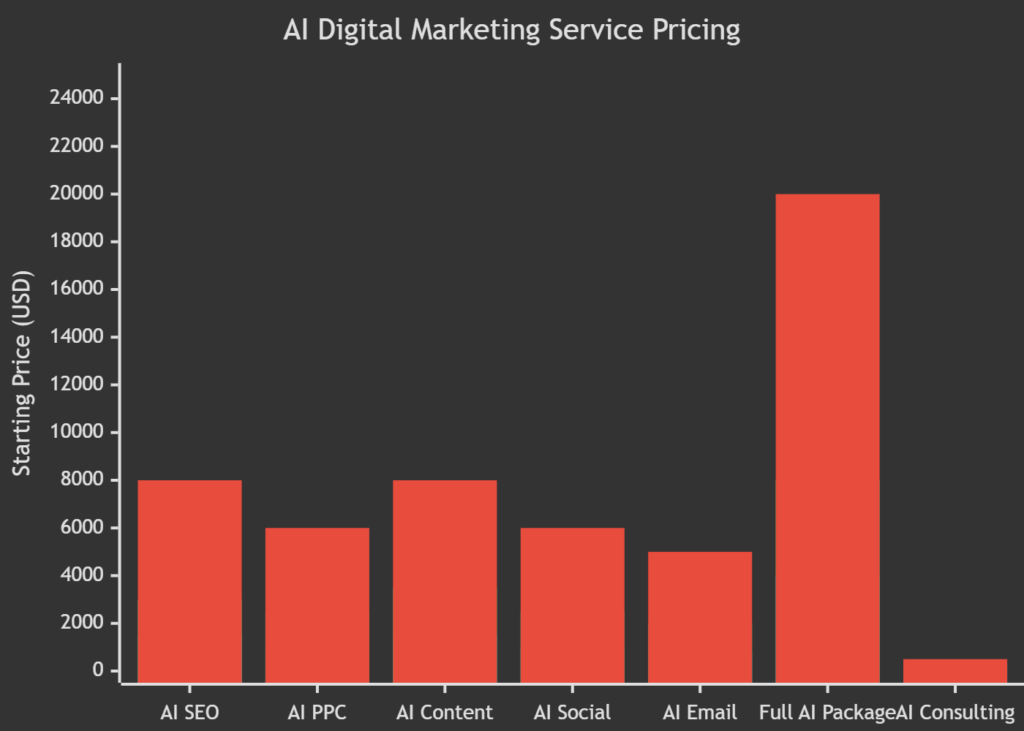
| AI Service Type | Entry Level | Mid-Market | Enterprise |
| AI SEO services | $1,500–$3,000/mo | $3,000–$8,000/mo | $8,000–$25,000+/mo |
| AI PPC services | $1,000–$2,500/mo + spend | $2,500–$6,000/mo + spend | $6,000–$20,000+/mo + spend |
| AI content marketing services | $1,500–$3,500/mo | $3,500–$8,000/mo | $8,000–$25,000+/mo |
| AI social media services | $1,000–$2,500/mo | $2,500–$6,000/mo | $6,000–$15,000+/mo |
| AI email marketing services | $800–$2,000/mo | $2,000–$5,000/mo | $5,000–$15,000+/mo |
| Full AI digital marketing package | $4,000–$8,000/mo | $8,000–$20,000/mo | $20,000–$60,000+/mo |
| AI marketing consulting | $200–$350/hr | $350–$500/hr | $500–$1,000+/hr |
A critical pricing note: AI digital marketing packages from reputable providers cost more than equivalent conventional marketing services — and should. The performance premium from AI-integrated execution (lower CPA, higher conversion rates, faster content production, more sophisticated optimization) more than justifies the investment differential when the provider’s AI capabilities are genuine and their results are documented.
Evaluating AI Marketing Tools vs AI Marketing Agencies
The build-versus-buy question in AI marketing is particularly relevant in 2025:
| Build With AI Tools (DIY/In-House): You have marketing team members with AI tool proficiencyYour primary need is AI for content creation and basic optimizationMonthly tool budget of $200–$800 is viableYou can invest 10–15 hrs/week on AI-assisted marketingYour primary channels are SEO, email, and social contentYou need rapid iteration and direct control over execution | Hire AI Marketing Services (Agency/Consultant): You need AI applied to PPC, advanced analytics, or full-funnelYou lack internal team capacity for AI tool managementRevenue impact justifies $3,000–$15,000+/month investmentYou need cross-channel AI integration and attributionYou want access to proprietary AI tools and workflowsPerformance accountability is a non-negotiable requirement |
AI Marketing Risks, Ethics, and What Forward-Thinking Brands Are Getting Right
The responsible deployment of AI in digital marketing requires confronting the risks and ethical considerations that the technology introduces — not as obstacles to adoption, but as frameworks for deploying AI in ways that build long-term trust rather than short-term gains that erode it.
The Real Risks of AI in Digital Marketing
- Content quality degradation: Organizations that deployed AI content generation without editorial governance flooded their sites with low-quality, generic content — earning Google Helpful Content penalties and audience trust erosion that took months to recover from
- Over-automation and brand voice loss: Businesses that fully automated customer communication through AI chatbots and AI-generated email found that their distinctive brand voice disappeared — replaced by a generic AI tone that failed to differentiate them in competitive markets
- Data privacy and compliance: AI personalization systems that collect and process customer behavioral data must comply with GDPR, CCPA, and emerging AI-specific regulations. Privacy-by-design in AI marketing infrastructure is not optional — it is a legal and reputational requirement
- Algorithmic bias: AI targeting and personalization systems trained on historical data can perpetuate and amplify existing biases — excluding demographic groups from targeting, reinforcing stereotypes in creative content, or systematically undervaluing certain customer segments
- Transparency and disclosure: Audiences increasingly expect disclosure when they are interacting with AI-generated content or AI-powered communication systems. Brands that are transparent about their AI use build trust; those that obscure it risk significant reputational damage when disclosure is demanded
What Ethical AI Marketing Looks Like in Practice
The brands building the most durable competitive advantages through AI marketing operate with specific principles:
- Human oversight at every consequential decision point — AI executes, humans govern
- Editorial review of all AI-generated content before publication — no exceptions
- Clear privacy policies and consent mechanisms for all AI-powered personalization
- Regular bias audits of AI targeting and recommendation systems
- Transparent labeling of AI-generated content where audience trust is at stake
- First-party data strategies that respect customer privacy while enabling personalization
| ⚠️ The Trust Imperative: The brands that will extract the greatest long-term value from AI in digital marketing are those that deploy it in service of genuinely helping their customers — not those that deploy it to manufacture trust through synthetic personalization at scale. Audiences are becoming increasingly sophisticated at detecting AI-generated inauthenticity, and the reputational cost of this detection is high. |
Your AI Digital Marketing Implementation Roadmap — Start to Scale
Understanding AI in digital marketing is the foundation. Building and executing an implementation roadmap is what creates the competitive advantage. Here is the phased framework for moving from AI awareness to AI-integrated marketing operations.
1.Phase 1: Foundation and Quick Wins (Month 1–2)
- Audit your existing platforms for embedded AI: Which AI features are already available in your Google Ads, Meta Ads, email platform, and website analytics that you are not yet using? Enable and configure these first — they represent zero-incremental-cost AI gains.
- Implement clean conversion tracking: AI optimization is only as good as the data it trains on. Audit your Google Analytics 4 configuration, Google Ads conversion tracking, and Meta Pixel implementation. Fix every gap before attempting AI-driven campaign optimization.
- Start AI-assisted content production: Introduce an AI writing assistant into your content workflow. Document the workflow: brief → AI draft → human enrichment → AI SEO optimization → human editorial review → publication.
- Enable Google Smart Bidding: If running Google Ads with sufficient conversion data (50+ conversions in 30 days), switch from manual CPC or enhanced CPC to Target CPA or Target ROAS. Monitor performance for 30 days before drawing conclusions.
What for the month 3-5
2.Phase 2: Personalization and Automation (Month 3–5)
- Implement AI email personalization: Enable send-time optimization, AI subject line testing, and behavioral segmentation in your email platform. Build your first AI-informed welcome and nurture sequences with dynamic content blocks.
- Add an AI content optimization tool: Integrate Surfer SEO, Clearscope, or Frase into your content workflow and optimize all new content before publication. Audit and re-optimize your 10 highest-traffic existing pages.
- Launch AI chatbot for lead capture: Deploy a conversational AI chatbot on your highest-traffic pages with a clear qualification flow and lead capture mechanism. Measure conversation-to-lead conversion rate versus static form baseline.
- Test Meta Advantage+ campaigns: If running Meta advertising, launch an Advantage+ Shopping Campaign (ecommerce) or Advantage+ Audience campaign (lead generation) alongside your manually managed campaigns. Let the AI run for 30+ days before comparing performance.
What for the month 6-12
3.Phase 3: Intelligence and Scale (Month 6–12)
- Implement predictive lead scoring: Integrate your CRM with an AI lead scoring system. Define what signals predict conversion in your specific sales context and configure the model accordingly. Measure sales team efficiency before and after.
- Build AI reporting infrastructure: Implement a marketing analytics platform with AI anomaly detection and attribution modeling.
- Evaluate AI agency partnership: If in-house AI marketing capabilities are constrained, use the evaluation criteria in Section 9 to identify an AI-powered marketing agency partner aligned with your primary growth channels and objectives.
- Develop first-party data strategy: Map every customer touchpoint where first-party data can be collected with consent.
| 🚀 The AI Marketing Imperative: The window for building an AI-driven competitive advantage in digital marketing is open — but it is not infinite. The businesses that move deliberately and strategically in the next 12 months will establish compounding AI advantages in their organic rankings, their paid performance, their email automation, and their customer intelligence that will take competitors years and significant investment to close. AI in digital marketing is not the future. It is the present. And the present demands action. |
Conclusion: The AI Marketing Advantage — Build It Now or Buy It Back Later
AI in digital marketing has crossed the threshold from early adoption to mainstream integration. The businesses reading this guide in 2025 are not deciding whether AI will impact their marketing — that decision has already been made by the market. They are deciding whether they will build AI marketing capabilities proactively, on their own terms, with strategic intention — or reactively, at a cost premium, after the competitive gap has forced their hand.
We have mapped the complete landscape: how AI in digital marketing is transforming SEO through semantic intelligence and automated optimization; how AI PPC optimization is delivering lower CPA and higher ROAS through real-time bidding intelligence; how AI content marketing tools are enabling quality at scale when governed with editorial discipline; how AI social media marketing is producing better-targeted, better-performing campaigns; how AI email marketing automation is generating personalization-driven revenue that manual segmentation cannot match; and how AI lead generation tools and predictive analytics are shifting the efficiency frontier for every business’s revenue operations.
The AI digital marketing services and tools documented in this guide are not experimental — they are operational. They are producing documented results for businesses across every sector, at every scale, on every budget level. The question is not whether they work. The question is whether your business is capturing the advantage they offer.
The brands that will define their markets in 2030 are building their AI marketing foundations today. The compound advantage of starting now versus starting in 12 months is not linear — it is exponential. AI in digital marketing does not wait. Neither should you.
FAQs
AI in digital marketing helps businesses analyze customer behavior, automate campaigns, personalize content, optimize ads, and improve targeting accuracy. This leads to higher-quality leads, better conversion rates, reduced ad spend waste, and faster business growth for companies ready to scale their online marketing efforts.
AI can improve multiple digital marketing services, including SEO, PPC advertising, email marketing, content creation, social media marketing, customer support automation, lead generation, and marketing analytics. Businesses using AI-powered marketing strategies often achieve faster optimization and better ROI compared to traditional methods.
Yes. AI in digital marketing helps small businesses compete more effectively by automating repetitive tasks, improving audience targeting, reducing marketing costs, and increasing campaign performance. Many businesses see improved efficiency and stronger customer engagement after implementing AI-driven marketing solutions.
When choosing an agency, look for proven experience with AI-powered campaigns, transparent reporting, industry-specific strategies, automation expertise, SEO and PPC knowledge, and measurable case studies. The right agency should focus on increasing conversions, revenue, and long-term business growth rather than just traffic.
Businesses using AI in digital marketing can expect improved customer targeting, higher ad performance, better personalization, faster campaign optimization, increased lead generation, stronger customer retention, and improved return on investment. Results often depend on strategy quality, business goals, and the effectiveness of AI implementation.
Author Bio

Purvansh Infotech is a next-generation AI digital marketing agency helping brands scale faster with data-driven strategies, automation, and performance intelligence. Purvansh Infotech is an AI-driven digital marketing agency built to help ambitious brands scale faster, smarter, and more profitably. We combine artificial intelligence, performance marketing expertise, and data-led strategy to turn digital activity into measurable revenue growth.