Neither works “better”—they serve different intents. Social media marketing builds immediate brand awareness and fast engagement, while SEO drives intent-driven, long-term traffic growth and high-converting leads.
For maximum business growth and ROI, don’t choose. Invest in both: use social media for instant traction and SEO for sustainable, compounding revenue.
Every business owner hits the same wall. You have a limited budget, limited time, and two powerful digital marketing channels pulling you in opposite directions. Do you invest in SEO and wait months for results? Or do you go all-in on social media and start getting attention today?
This guide breaks down social media marketing vs SEO from every angle — cost, speed, ROI, lead quality, and long-term growth — so you can make a real decision for your business.
Introduction to SEO and Social Media Marketing
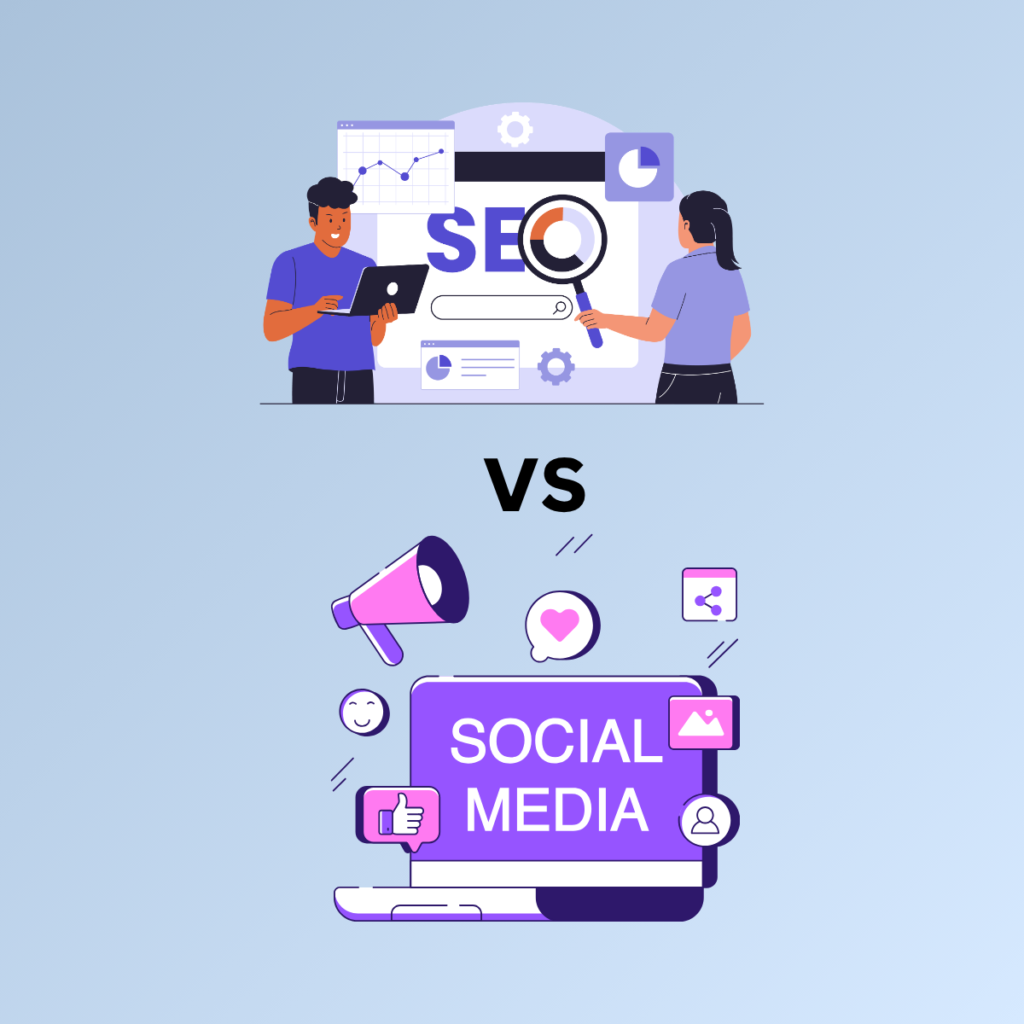
Think of social media marketing vs SEO as two sides of the same coin. Social media pushes your brand out to generate fast awareness and community engagement. SEO pulls actively searching buyers to your site.
The core difference? Social media sparks instant discovery, while SEO secures compounding, long-term traffic growth. Your business needs both.
Why Businesses Compare SEO and Social Media Marketing
Most businesses do not have the budget to do everything at once. When resources are tight, every marketing dollar needs to justify itself. Social media marketing vs SEO is one of the most searched comparisons in digital marketing because the stakes are real — wrong choice, wasted money.
Both channels can drive traffic, build brand awareness, and generate leads. But they do it in completely different ways, on completely different timelines, with completely different costs.
The Difference Between Search Intent and Social Engagement
When someone opens Google and types a query, they are looking for something specific. That is search intent. SEO captures that moment — the exact second a buyer is ready to find a solution.
Social media works differently. People scroll through feeds to be entertained, informed, or connected. They are not always looking to buy. Your job is to interrupt their scroll in a way that builds enough trust to bring them back later.
What This Guide Will Help You Decide
By the end of this guide, you will know which channel fits your budget, your timeline, and your business model. You will also understand when combining social media marketing vs SEO makes more sense than choosing one over the other.
How SEO Works for Business Growth
SEO is the process of optimizing your website so that search engines rank your pages higher in organic results. When done right, it becomes a traffic machine that works around the clock without paying for every click.
How Search Engines Drive Organic Traffic
- Google processes over 8.5 billion searches every single day
- Organic results get significantly more clicks than paid ads for most informational and commercial queries
- The top three Google results capture the majority of all clicks on a given search
- Traffic from SEO compounds over time — a page ranked today can bring visitors for years
The Role of Keywords and Search Intent
- Keywords are the bridge between what people search and what your content offers
- Targeting the right keywords means reaching people at the exact moment they need your product
- Long-tail keywords (3+ words) often have lower competition and higher purchase intent
- Matching content to search intent — informational, navigational, or transactional — is what separates ranked pages from invisible ones
Why SEO Builds Long-Term Visibility
SEO is one of the few digital marketing strategies where your past work keeps paying dividends. A blog post you published two years ago can still rank on page one and bring in leads every week. You are not renting attention — you are building an asset.
That long-term compounding effect is the single biggest reason businesses invest heavily in SEO for long-term traffic growth. The returns do not stop the moment you pause your spending.
Common SEO Challenges Businesses Face
- Results take time — typically 3 to 6 months before meaningful traffic kicks in
- Algorithm updates can shake rankings overnight, requiring constant adaptation
- Technical SEO (site speed, crawlability, Core Web Vitals) adds complexity most small teams are not prepared for
- High-competition niches require serious content investment and backlink building to break through
How Social Media Marketing Works
When mapping social media marketing vs SEO for business growth, SEO acts as your ultimate long-term asset. It positions your brand directly in front of high-intent prospects at the exact moment they want to buy.
Unlike social feeds that refresh instantly, SEO builds an enduring foundation for sustained traffic growth and compounding ROI. Use it now.
Social media marketing is the practice of using platforms like Instagram, Facebook, TikTok, LinkedIn, and X to build audiences, promote content, and drive business results. It is one of the fastest ways to put your brand in front of people.
How Social Platforms Generate Brand Attention
- Algorithms push content to users based on engagement signals — likes, shares, comments, saves
- A single viral post can reach millions of people without spending a cent
- Visual platforms like Instagram and TikTok create emotional connections faster than text-based content
- Community building through social media creates loyal audiences that follow your brand across platforms
Organic Social Media vs Paid Advertising
- Organic social media is free but requires consistent effort and quality content to build reach
- Paid social (Facebook Ads, Instagram Ads, TikTok Ads) allows precise targeting by age, interest, behavior, and location
- Paid social can generate results within 24 hours of launching a campaign
- Organic reach on most platforms has declined significantly over the past decade — paid amplification is increasingly necessary
The Power of Viral and Shareable Content
- Content that triggers emotion — humor, surprise, inspiration — spreads organically across networks
- User-generated content and community challenges can extend brand reach without ad spend
- Short-form video on TikTok and Instagram Reels currently delivers the highest organic reach of any content format
- Virality is unpredictable, but it can give a small brand the exposure of a company ten times its size overnight
Common Social Media Marketing Challenges
- Organic reach continues to decline across major platforms as they push paid advertising
- Platform algorithm changes can wipe out a brand’s reach with no warning
- Social media demands constant content production to stay relevant and visible
- Follower counts do not always translate into sales — vanity metrics can mask poor conversion performance
SEO vs Social Media Marketing — Core Differences
The fundamental difference between social media marketing vs SEO comes down to intent and lifespan. Social media captures immediate attention through discovery and disruption, making it perfect for rapid brand awareness.
SEO, by contrast, intercepts active search intent, positioning your business to capture high-converting leads and secure sustainable, long-term traffic growth. One pushes, the other pulls.
| Factor | SEO | Social Media Marketing |
|---|---|---|
| Primary Traffic Source | Google, Bing, Yahoo organic results | Facebook, Instagram, TikTok, LinkedIn, X feeds |
| Traffic Type | Pull-based (user searches actively) | Push-based (content served to passive scrollers) |
| Average Monthly Organic Traffic Potential | Unlimited — scales with content & authority | Limited by algorithm reach & posting frequency |
| Average Click-Through Rate (CTR) | Position 1: ~27.6% / Position 2: ~15.8% / Position 3: ~11% | Organic post reach: 1–5% of followers on most platforms |
| Time to First Results | 3–6 months for meaningful traffic | 24–72 hours for first impressions |
| Time to Peak Performance | 12–24 months | 48–96 hours per post (then drops sharply) |
| Content Lifespan | 2–5 years (evergreen content) | 24–48 hours (Instagram/Facebook) / 7 days (LinkedIn) |
| Average Cost Per Click (Organic) | $0 per click once ranked | $0 per click (organic) — but reach is shrinking |
| Average Cost Per Click (Paid) | Google Ads: $1–$6 average across industries | Facebook/Instagram: $0.50–$3.00 / LinkedIn: $5–$10+ |
| Average Cost Per Lead | $14–$60 (varies by industry, long-term) | $21–$80 (paid social, varies by platform) |
| SEO Monthly Investment (SMB) | $500–$5,000/month | $1,000–$10,000+/month (paid social for results) |
| Average Conversion Rate | 2.4%–14.6% (organic search traffic) | 0.5%–1.5% (organic social) / 1%–4% (paid social) |
| ROI Timeline | Positive ROI typically at month 6–12 | Positive ROI possible within week 1 (paid) |
| Long-Term ROI | Very High — compounds over time | Moderate — stops when budget stops |
| Lead Quality (Intent Score) | High — user initiated the search | Low to Medium — interruption-based discovery |
| Buyer Funnel Stage Captured | Middle & Bottom (research + decision) | Top of funnel (awareness + discovery) |
| Average Session Duration from Channel | 2–4 minutes (search traffic) | 45 seconds–2 minutes (social traffic) |
| Bounce Rate | 26%–65% (varies by industry) | 55%–75% (social referral traffic tends to be higher) |
| Brand Awareness Speed | Slow — builds over months | Fast — can reach millions within hours |
| Brand Authority Building | Very High — ranking = perceived expertise | Medium — depends on engagement & follower count |
| Algorithm Dependence | Moderate — Google updates ~4,000x/year | Very High — organic reach dropped 50%+ since 2019 |
| Platform Control | You own your website and rankings | Platform owns your reach and can suspend accounts |
| Scalability | High — traffic grows without proportional cost increase | Moderate — scaling requires proportional budget increase |
| Content Format | Long-form articles, landing pages, product pages | Short-form video, images, stories, carousels, reels |
| Keyword/Topic Data Available | Yes — Google Search Console, SEMrush, Ahrefs | Limited — native analytics only |
| Targeting Capability | Intent-based keyword targeting | Demographic, interest, behavioral, lookalike targeting |
| Audience Retargeting | Limited (requires paid Google Ads layer) | Very Strong — Facebook Pixel, TikTok Pixel, etc. |
| Virality Potential | Very Low | Very High — content can reach millions organically |
| Backlink Value | Critical — directly impacts rankings | No direct SEO ranking value |
| Local Business Suitability | Excellent — local SEO drives high-intent foot traffic | Moderate — good for awareness, weak for direct leads |
| E-commerce Suitability | Excellent for research-phase buyers | Excellent for impulse and discovery-phase buyers |
| B2B Suitability | Very High — buyers research heavily on Google | High for LinkedIn / Low for Instagram, TikTok |
| Startup Suitability | Medium — slow start but strong long-term | High — fast visibility with minimal setup |
| Measurability | High — rankings, traffic, conversions all trackable | High — impressions, reach, clicks, ROAS trackable |
| Skill Requirements | Technical SEO, content writing, link building | Content creation, community management, paid ads |
| Team Size Needed (SMB) | 1–3 people (SEO strategist + writer) | 1–4 people (content creator + ad manager) |
| Dependency on Paid Budget | Low — organic SEO works without ad spend | High — organic reach alone rarely drives business results in 2026 |
| Compounding Effect | Yes — every piece of content adds to domain authority | No — each post starts from zero reach |
| Best For | Long-term traffic, lead generation, authority | Brand awareness, community building, fast launches |
| Worst For | Immediate results, trend-driven campaigns | Sustained lead generation without ongoing budget |
This is where social media marketing vs SEO becomes a direct comparison. These are not two versions of the same thing. They are fundamentally different channels with different strengths.
Traffic Source Comparison
- SEO drives traffic from search engines — people actively looking for answers, products, or services
- Social media drives traffic from feeds — people passively discovering content while doing something else
- SEO traffic is pull-based; social traffic is push-based
- Search traffic tends to be more consistent; social traffic can spike and crash based on algorithm changes or posting frequency
Audience Intent Comparison
- Search visitors arrive with a clear purpose — they typed something specific and clicked your result
- Social visitors arrive with interest at best, curiosity at minimum — they saw something and tapped
- Higher intent from search generally means faster movement through the buying cycle
- Social platforms are better for top-of-funnel awareness, while SEO captures mid-to-bottom-funnel buyers
Conversion Potential Comparison
- SEO pages optimized for transactional keywords (buy, best, review, compare) convert at higher rates than most social traffic
- Social media ads with retargeting can achieve strong conversion rates, especially for e-commerce
- Organic social media has notoriously low direct conversion rates — most conversions happen after multiple touchpoints
- Landing pages driven by SEO traffic typically outperform social traffic in direct conversion metrics
Long-Term Value Comparison
- SEO builds compounding value — content and links accumulate authority over time
- Social media has near-zero long-term value from individual posts — yesterday’s post is invisible today
- A top-ranking SEO page can generate leads for 3 to 5 years with minimal maintenance
- Social accounts require continuous posting to maintain any level of reach or relevance
Scalability Comparison
- SEO scales through content production, link acquisition, and technical optimization — each effort builds on the last
- Social media scales through budget (paid ads) or virality — both unpredictable without serious investment
- SEO compounds; social media must constantly be fed
- Businesses that invest in SEO early reach a point where cost-per-visitor drops significantly over time
Which Delivers Faster Results?

When evaluating social media marketing vs SEO for speed, social media wins outright. It delivers near-instant visibility, rapid brand awareness, and immediate traffic spikes.
SEO is a long-term play that takes months to rank. If your business needs urgent traffic, leads, and immediate market feedback today, deploy social media marketing right now while building your SEO foundation.
Speed is often the deciding factor for businesses just starting out or running tight on cash. Social media marketing vs SEO tells two very different stories when it comes to timelines.
Why Social Media Produces Faster Visibility
Social media is the fastest way to get eyes on your brand without spending years building authority. You can launch a profile today, post content tomorrow, run an ad by the end of the week, and have real people engaging with your brand within days.
For businesses that need immediate brand awareness or are testing a new product, social media is unmatched in speed. A well-crafted TikTok or Instagram Reel can generate thousands of impressions within 48 hours of posting.
Why SEO Requires More Time
SEO is a long game. Search engines need time to crawl and index your content, evaluate your domain authority, and test your rankings against competitors. Most new websites will not see meaningful organic traffic for 3 to 6 months, and competitive keywords can take 12 months or more to rank for.
This does not mean SEO is slow — it means the results are delayed. The work you do in month one pays off in month six. And the results you see in month six keep compounding through year two and beyond.
Short-Term Marketing vs Long-Term Growth
- Social media is the better choice for immediate results, product launches, and time-sensitive campaigns
- SEO is the better choice for sustainable, long-term traffic that does not evaporate when you stop posting
- The best businesses use social media to win the short game while building SEO to win the long game
- Short-term thinking favors social; long-term thinking favors SEO
Which Is Better for Immediate Sales?
- Paid social ads (Meta, TikTok, Pinterest) can drive immediate e-commerce sales with strong creative and precise targeting
- Google Shopping and paid search ads can also drive fast results, but that is paid search — not organic SEO
- Organic SEO takes months before it can reliably support sales
- If you need sales this week, social media advertising wins — organic SEO is not in the conversation
Cost Comparison Between SEO and Social Media Marketing
When looking at the cost-effectiveness of social media marketing vs SEO, social media requires a lower initial barrier to entry but demands ongoing ad spend or constant content creation to sustain visibility.
SEO demands a higher upfront investment for optimization and content assets. However, it is more cost-effective over time, delivering compounding, free organic traffic for long-term growth.
Budget is where decisions get real. Both channels cost money — just in different ways.
AVERAGE COST PER CLICK (CPC)
| Channel | CPC |
|---|---|
| SEO Organic | $0 |
| Google Ads (Search) | $4.22 |
| Facebook Ads | $1.72 |
| Instagram Ads | $3.56 |
| LinkedIn Ads | $8.39 |
| TikTok Ads | $1.00 |
| Pinterest Ads | $1.50 |
AVERAGE COST PER LEAD (CPL)
| Channel | CPL |
|---|---|
| SEO (Organic) | $14 |
| Email Marketing | $23 |
| Social Media Organic | $32 |
| Facebook Ads | $52 |
| Instagram Ads | $58 |
| Google Ads | $65 |
| LinkedIn Ads | $98 |
MONTHLY INVESTMENT TO SEE RESULTS (SMB)
| Strategy | Monthly Spend |
|---|---|
| DIY SEO (tools only) | $100 |
| SEO Freelancer | $1,500 |
| SEO Agency | $3,500 |
| Organic Social Only | $0 |
| Paid Social (starter) | $1,000 |
| Paid Social (growth) | $5,000 |
| Paid Social (scale) | $15,000 |
ROI COMPARISON OVER TIME (Per $1,000 invested)
| Month | SEO Return | Paid Social Return |
|---|---|---|
| Month 1 | $0 | $900 |
| Month 3 | $200 | $950 |
| Month 6 | $800 | $1,000 |
| Month 12 | $2,500 | $1,050 |
| Month 18 | $4,800 | $1,100 |
| Month 24 | $8,000 | $1,150 |
SEO Investment and Maintenance Costs
- Initial SEO setup (technical audit, keyword research, on-page optimization) typically costs between $1,000 and $5,000 for small businesses
- Ongoing SEO (content creation, link building, maintenance) runs $500 to $5,000 per month depending on competition and goals
- In-house SEO requires hiring writers, strategists, and sometimes technical developers
- The cost of SEO does not scale linearly with traffic — traffic grows while costs stabilize or decrease over time
Social Media Advertising Costs
- Facebook and Instagram ads typically run $0.50 to $3.00 per click depending on the industry and audience
- TikTok ads can reach audiences at lower cost-per-thousand impressions (CPM) but require creative-heavy production
- LinkedIn ads are the most expensive in social advertising, often exceeding $5 to $10 per click — but deliver B2B audiences not reachable elsewhere
- Monthly social ad spend for meaningful results typically starts at $1,000 to $3,000 for small businesses
Cost Per Lead Comparison
- SEO-generated leads typically cost less over time because the content keeps working without additional spend
- Social media leads cost money every single time — stop paying, stop getting leads
- E-commerce brands often find social media cost-per-acquisition (CPA) higher but faster than SEO-driven conversions
- B2B businesses report that SEO leads convert at significantly higher rates, making the cost per closed deal lower despite longer timelines
Which Strategy Gives Better ROI?
SEO delivers better ROI over a 12-to-24-month horizon in most business categories. The compounding nature of organic traffic means cost-per-visit drops dramatically as your content library grows. A single well-optimized blog post can generate hundreds of leads over several years at no additional cost.
Social media delivers better short-term ROI when campaigns are precisely targeted and creative is strong. But the moment you stop spending, results stop. SEO vs social media ROI is not a close call over the long run — SEO wins consistently for businesses that can afford to wait.
SEO vs Social Media for Lead Generation
Comparing social media marketing vs SEO for lead generation, SEO holds the clear advantage in conversion quality. Search engine optimization targets users with high purchase intent who are actively seeking solutions, capturing highly qualified leads.
Social media builds volume and captures early-stage prospects, but SEO converts at a higher rate, ensuring stable, long-term business growth.
Which Channel Brings Higher-Intent Leads?
SEO wins this category clearly. A person who searches “best accounting software for freelancers” and lands on your comparison page is further down the buying funnel than someone who scrolled past your Instagram ad while watching cooking videos.
Search intent creates a natural filter. The leads that arrive through SEO are pre-qualified by the very act of searching. They have a problem, they are looking for a solution, and they found your page.
Lead Quality Differences
- SEO leads come pre-qualified — they searched for exactly what you offer
- Social media leads require more nurturing because they did not arrive with purchase intent
- B2B companies consistently report higher lead quality from SEO than social media
- E-commerce businesses find social leads valuable for impulse purchases but less reliable for high-ticket items
Customer Journey Comparison
- SEO captures buyers at the middle and bottom of the funnel — research phase and decision phase
- Social media excels at top-of-funnel brand introduction and retargeting people who already visited your site
- A customer might discover you on Instagram, forget about you, then search for you on Google three weeks later
- The customer journey increasingly blends both channels — touchpoints from social and search work together
Which Converts Better Into Paying Customers?
For most industries, SEO traffic converts into paying customers at a higher rate than cold social media traffic. This is especially true for service businesses, SaaS companies, and high-ticket products where buyers do extensive research before committing.
For impulse-driven e-commerce purchases — fashion, accessories, food products — social media ads can convert exceptionally well with the right creative and offer. SEO vs social media lead generation depends heavily on what you sell and how your customers buy.
SEO vs Social Media for Brand Awareness
In the debate of social media marketing vs SEO for brand awareness, social media is the undisputed winner. It allows you to visually showcase your identity, spark conversations, and go viral.
While SEO introduces you to people already searching for your product, social media actively injects your brand into daily feeds, building widespread visibility and recognition much faster.
Building Authority Through SEO
SEO builds authority differently than social media. When your website consistently ranks on page one for important industry keywords, people associate your brand with expertise. They see you repeatedly in search results across different topics — and that repeated visibility builds credibility without any paid promotion.
Being the brand that always shows up in search creates a form of authority that is hard to manufacture on social platforms. It signals to buyers that you are a trusted source in your space.
Building Community Through Social Media
- Social media for brand awareness creates emotional connections that search results cannot replicate
- Comments, replies, live sessions, and stories make brands feel human and approachable
- Community-driven brands on social platforms generate word-of-mouth referrals that no algorithm can buy
- Brands that build genuine communities on social media benefit from free organic amplification through shares and tags
Trust and Credibility Comparison
- Ranking on Google builds implicit trust — the algorithm is seen as an objective authority
- Social media credibility is tied to follower count, engagement rate, and content quality — all of which can be gamed
- Buyers trust a Google search result differently than a sponsored post in their feed
- Over time, SEO-driven trust is deeper because it is earned through content quality and relevance, not paid reach
Which Builds Stronger Brand Loyalty?
Social media wins on emotional brand loyalty. The daily or weekly presence in someone’s feed creates familiarity that a blog post cannot. Brands that show personality, respond to comments, and create content that resonates with their community build loyalty faster through social platforms.
SEO builds a different kind of loyalty — the kind where customers return to your site because your content reliably answers their questions. Both are valuable. But for emotional brand attachment, social media has the edge.
Content Strategy Comparison
When building your content engine, the choice between social media marketing vs SEO dictates your format. Social media relies on short-form, trendy, highly visual content to capture fleeting attention.
Conversely, SEO requires deep, high-quality, comprehensive content that solves specific problems. Align both strategies immediately: repurpose your long-term SEO assets into snappy social posts for maximum visibility.
Evergreen SEO Content vs Viral Social Content
- Evergreen SEO content answers questions that never expire — how-to guides, comparison articles, tutorials
- Viral social content is timely, trendy, and emotionally charged — it spikes fast and disappears faster
- SEO content compounds in value over months and years; social content has a lifespan measured in hours or days
- A great evergreen SEO article is a long-term business asset; a viral TikTok is a moment
Blog Articles vs Short-Form Video Content
- Long-form blog articles (1,500 to 3,000+ words) are the backbone of most successful SEO strategies
- Short-form video (15 to 90 seconds) dominates social media and currently receives the most algorithmic favor
- Blog content requires depth, research, and keyword optimization — it takes time to produce well
- Short-form video requires creative energy, consistency, and a strong hook in the first two seconds
Search-Based Content vs Engagement-Based Content
- SEO content is built around what people search — keyword data drives every topic decision
- Social content is built around what people engage with — trending sounds, formats, and emotions drive performance
- Search-based content attracts people with problems to solve; engagement-based content attracts people with time to fill
- The content strategies require completely different skills, tools, and mindsets
Content Lifespan Comparison
- A well-optimized SEO blog post can rank and drive traffic for 2 to 5 years
- An Instagram post reaches most of its audience within 24 to 48 hours of publishing
- A TikTok video can resurface weeks later but most lose momentum within the first few days
- YouTube sits between both worlds — videos can rank in Google and surface in YouTube search for years
Best Strategy Based on Business Type
The winner of social media marketing vs SEO depends entirely on your business model. If you are in B2B, local services, or high-intent e-commerce, prioritize SEO to capture buyers actively searching for solutions.
If you are a consumer startup or a visual brand, lead with social media for fast awareness. Tailor your focus to match user intent today.
Best Option for E-commerce Businesses
E-commerce businesses benefit enormously from both channels, but in different ways. Social media advertising — particularly Meta Ads and TikTok Ads — is the fastest path to product discovery and impulse purchases. SEO vs social media for ecommerce often lands on a both answer, but with different priorities at different stages.
Early-stage e-commerce brands with unique products should lean on social media ads for rapid testing. Established e-commerce brands should invest heavily in SEO to build category pages, product pages, and comparison content that captures buyers in research mode.
Best Option for Local Businesses
Local businesses are one category where SEO delivers clearly superior results. Local SEO — optimizing for “near me” searches and Google Business Profile — connects businesses with buyers in their area who are actively looking for a service.
- Local SEO vs social media is not close for service businesses like plumbers, dentists, or electricians
- A person searching “emergency plumber near me” is ready to buy — a person scrolling Instagram is not
- Google Business Profile optimization is free and one of the highest-ROI local marketing actions
- Social media for local businesses works better for community building and loyalty than direct lead generation
Best Option for Startups
Startups face a unique challenge: they need visibility fast but often lack the budget for sustained paid campaigns. SEO vs social media for startups depends on the product and the founder’s strengths.
- Startups with content-driven products (SaaS, education, tools) should prioritize SEO from day one
- Startups with visual or lifestyle products should lean on social media for initial traction
- Founder-led social media content is one of the most cost-effective brand awareness strategies for early-stage companies
- Building SEO while growing a social audience creates a compound growth engine over 12 to 18 months
Best Option for SaaS Companies
SaaS companies live and die by organic search. The buyers of software products research extensively before committing — they read comparison articles, watch review videos, and read case studies. SEO captures that entire research journey.
- SaaS brands that dominate search rankings for category keywords generate enormous volumes of qualified trial signups
- Social media for SaaS works best for LinkedIn B2B content and retargeting people who visited the site
- Content marketing combined with SEO is the primary growth engine for most successful SaaS companies
- Paid social for SaaS has high costs and lower intent — it supports SEO, not replaces it
Best Option for Personal Brands
Personal brands thrive on social media. The human connection, the daily visibility, and the emotional storytelling that platforms like Instagram, LinkedIn, TikTok, and YouTube enable are perfectly matched to personal brand growth.
- Social media for personal brands builds the audience; SEO captures the people searching your name later
- Consistent content on one or two social platforms grows personal brand faster than SEO in the first year
- SEO matters for personal brands when they have a product, service, or course to sell through search
- The best personal brands use social media to build the audience and SEO to monetize the authority
SEO vs Social Media for E-commerce Growth
For e-commerce, the choice between social media marketing vs SEO hinges on discovery vs intent. Social media excels at impulse buys, lifestyle marketing, and fast influencer-driven conversions.
However, SEO targets buyers with a specific purchase intent, delivering lower customer acquisition costs. Combine both: use social media for immediate product drops and SEO for sustainable, long-term traffic growth.
Product Discovery Through Google Search
Google Shopping ads and organic product page SEO are critical for e-commerce businesses selling products people actively search for. Categories like “best running shoes under $100” or “wireless earbuds for gym” are searched millions of times per month by buyers ready to purchase.
Ranking for these product and category keywords through SEO puts your store directly in front of high-intent buyers. It does not require ad spend once the rankings are established — which is why product-level SEO is a core growth driver for mature e-commerce brands.
Product Discovery Through Social Platforms
- Instagram Shopping and TikTok Shop have made social commerce a real revenue channel for e-commerce brands
- Product discovery on social media is driven by lifestyle content, influencer endorsements, and aspirational visuals
- Impulse purchases are heavily driven by social media — seeing a product in context (on a person, in a home, in use) triggers buying decisions
- User-generated content on social platforms is one of the most effective drivers of e-commerce sales
Retargeting Opportunities Comparison
- Social media retargeting allows you to re-engage website visitors with highly targeted ads based on pages they visited
- SEO does not retarget directly, but remarketing tools can be combined with organic traffic to create retargeting audiences
- Retargeting through Facebook and Instagram pixel data is one of the highest-ROI uses of social media ad spend
- Combining SEO-driven traffic with social retargeting creates a powerful conversion loop
Customer Retention Strategies
- Email marketing connected to social followings is the strongest customer retention tool for e-commerce
- SEO-driven content (guides, tutorials, how-to posts) keeps existing customers engaged and returning
- Social media communities and loyalty programs built on social platforms drive repeat purchases
- The best e-commerce retention strategies use both channels: SEO content for education, social for community
Can SEO and Social Media Work Together?
Absolutely. Viewing social media marketing vs SEO as a rivalry is a mistake; they work better together. Social media amplifies your brand’s reach and gains fast visibility, driving social signals and backlinks that support your search presence.
Meanwhile, ranking well secures long-term traffic growth. Integrate both channels immediately to maximize your overall marketing ROI and visibility.
The most successful digital marketing strategies do not treat this as an either-or decision. Social media marketing vs SEO stops being the right question once a business reaches a certain size.
How Social Media Supports SEO Growth
- Social media distributes your content to audiences who may then link to it from their own websites — generating backlinks that improve SEO
- Increased brand searches (people typing your brand name into Google) signal authority to search engines
- Social engagement data can inform which content topics resonate — that insight shapes your SEO content strategy
- Videos and content that perform on social media can be repurposed into SEO-optimized blog posts and landing pages
Using SEO Content on Social Platforms
- Long-form SEO blog posts can be broken into multiple short-form social posts, extending their value
- SEO keyword research reveals what questions your audience has — answering those questions on social media drives engagement
- Data and statistics from SEO research make compelling infographic and carousel content for Instagram and LinkedIn
- The content investment in SEO is never wasted — it feeds a social content calendar too
Multi-Channel Marketing Strategies
- A multi-channel approach creates multiple touchpoints across the buyer journey
- A buyer might discover your brand through a TikTok video, research you on Google, and convert through an SEO blog post
- Running social media and SEO simultaneously shortens the time between first touch and conversion
- Businesses that use both channels consistently outperform those that rely on either alone
Building a Full-Funnel Traffic System
- Top of funnel: social media for brand awareness and discovery
- Middle of funnel: SEO content for research, comparison, and education
- Bottom of funnel: SEO landing pages and retargeted social ads for conversion
- This full-funnel system uses each channel where it is strongest — and the result is compounding revenue growth
Common Mistakes Businesses Make
The biggest mistake businesses make when weighing social media marketing vs SEO is treating them as mutually exclusive options. Relying solely on social media leaves you vulnerable to algorithm changes and kills long-term traffic growth.
Conversely, ignoring social channels means you miss immediate audience engagement. Stop treating them as competitors; unify both to secure sustained business growth.
Expecting SEO Results Too Quickly
One of the most common and costly mistakes is abandoning SEO after two or three months because rankings have not moved. SEO requires patience. The businesses that win with organic search are the ones that treat it as infrastructure — they build it knowing the payoff comes later.
Giving up on SEO before the 6-month mark almost always means leaving compounding traffic on the table. The businesses that stick with it consistently report it becoming their single largest source of qualified leads within 18 to 24 months.
Relying Only on Viral Social Media
- Building a business entirely on social media virality is building on rented land
- Platform algorithm changes can eliminate reach overnight with no recourse
- A single viral post does not build a sustainable business — consistent systems do
- Brands that rely solely on organic social reach often find themselves forced into paid advertising the moment reach declines
Ignoring Search Intent
- Publishing content without understanding search intent is one of the most common SEO mistakes
- A page optimized for an informational keyword will not convert buyers looking for a transactional page
- Misaligning content type with intent signals to Google that your page does not serve the searcher
- The same mistake happens on social media when brands post product content to audiences that need educational content first
Not Tracking Marketing ROI Properly
- Many businesses confuse vanity metrics (followers, impressions, likes) with actual business outcomes
- Tracking cost-per-lead, cost-per-acquisition, and revenue-per-channel is the only way to make informed budget decisions
- Attribution in digital marketing is complex — a buyer may touch six pieces of content before converting
- Businesses that do not track ROI properly consistently underinvest in their best channels and overspend on their worst ones
How to Choose the Right Strategy for Your Business
To choose between social media marketing vs SEO, evaluate your timeline and target audience’s intent. If your business needs immediate traffic, quick brand awareness, and fast customer engagement, prioritize social media.
However, if you want high-quality leads, sustainable revenue, and compounding, long-term traffic growth, invest heavily in SEO. For the best digital marketing strategy, balance both channels.
Choosing Based on Budget
- Under $1,000/month: Focus on organic SEO content and organic social media — paid channels require more budget to be effective
- $1,000 to $5,000/month: Split between SEO content production and paid social advertising for rapid testing
- $5,000 to $15,000/month: Run full SEO programs alongside paid and organic social strategies
- $15,000+/month: Build comprehensive multi-channel programs with dedicated specialists for each channel
Selecting Based on Business Goals
- Goal is immediate sales: prioritize paid social advertising and Google Shopping
- Goal is long-term organic traffic: prioritize SEO content and link building
- Goal is brand awareness and community: prioritize social media and influencer partnerships
- Goal is scalable lead generation: prioritize SEO with social media retargeting for conversion
Choosing Based on Competition Level
- Low competition niche: SEO can produce results faster and at lower cost
- High competition niche: social media advertising may generate results while SEO builds over time
- Dominated search results: look for long-tail keyword opportunities and build social media authority in parallel
- Local competition: local SEO typically offers the clearest path to qualified leads at lowest cost
Choosing Based on Growth Timeline
- Need results in 30 to 90 days: social media advertising is the answer
- Comfortable with a 6 to 12 month horizon: SEO is the primary investment
- Building a 3 to 5 year business asset: SEO compounding returns are unmatched
- Short campaign or event-driven promotion: social media every time
Why Businesses Choose Purvansh Infotech
Purvansh Infotech provides result-oriented digital marketing services designed to help businesses grow online effectively.
Services Offered
- SEO Services
- AI SEO Solutions
- Social Media Marketing
- PPC Advertising
- Content Marketing
- Website Design & Development
- Lead Generation
- Online Reputation Management
Why Choose Purvansh Infotech?
Experienced Professionals
A skilled team with expertise across multiple industries.
Customized Marketing Strategies
Tailored solutions based on business goals and target audience.
Affordable Services
Cost-effective solutions for startups, small businesses, and enterprises.
Data-Driven Approach
Strategies based on analytics and measurable results.
Long-Term Growth Focus
The goal is sustainable business growth and strong online presence.
What are the SEO vs Social Media Marketing Trends in 2026?
According to Reddit, In 2026, the lines blur between social media marketing vs SEO. SEO is transforming through Generative Engine Optimization (GEO), requiring structured answers to secure AI Overview citations. Meanwhile, social media has become the new search engine for younger demographics using TikTok and Reddit.
AI and the Future of SEO
AI has fundamentally changed search. Google’s AI Overviews now answer many queries directly on the search results page, reducing clicks to traditional blog content. At the same time, AI has made content production faster — meaning more competition for every keyword.
The SEO winners in 2026 are brands that produce genuinely expert, experience-driven content that AI cannot easily replicate. First-hand expertise, original data, and real case studies are the SEO differentiators that matter most right now.
The Rise of Short-Form Video Marketing
- TikTok, Instagram Reels, and YouTube Shorts dominate social engagement metrics in 2026
- Short-form video has the highest organic reach of any content format on social platforms
- Brands that have mastered short-form video are generating brand awareness at a fraction of traditional advertising costs
- The challenge is that short-form video trends move fast — what works today may not work in six months
Search Everywhere Optimization
- Consumers in 2026 search on Google, TikTok, YouTube, Reddit, Pinterest, and AI tools like ChatGPT
- SEO is no longer just about Google — it is about being findable wherever your audience looks for answers
- TikTok SEO (optimizing videos for in-app search) is now a real discipline that brands are investing in
- Brands that optimize for search across multiple platforms build more resilient traffic than those focused on Google alone
Future Consumer Behavior Trends
- Zero-click searches continue to rise as AI answers more queries without requiring a website visit
- Social commerce is growing — buyers complete purchases without leaving social platforms
- Trust is increasingly earned through community and authenticity rather than search rankings alone
- The businesses that win long-term will be those that build genuine authority across both search and social ecosystems
Last Notes : Which Works Better?
The final verdict on social media marketing vs SEO depends on your objective. For instant visibility, engagement, and fast brand awareness, social media is superior. For high-intent leads, maximum cost-effectiveness, and sustainable, long-term traffic growth, SEO wins.
The best digital marketing strategy isn’t choosing one—it’s using social media for immediate traction while building an SEO foundation for compounding ROI.
After examining every angle of social media marketing vs SEO, the honest answer is: it depends on your business, your budget, and your timeline. But here is what the data and experience consistently show.
When SEO Is the Better Choice
- You are building a long-term business and can invest for 6 to 18 months before expecting significant returns
- Your product or service is something people actively search for
- You want a marketing channel that compounds in value and does not stop working when you stop paying
- You are in a category where buyers research extensively before purchasing
When Social Media Marketing Is the Better Choice
- You need visibility and results quickly — within weeks, not months
- You have a visually compelling product or lifestyle brand that photographs or films well
- You are targeting a specific demographic that lives on a particular platform
- You are launching something new and need to generate buzz and awareness fast
Why Combining Both Creates the Strongest Strategy
The businesses that grow fastest are not choosing between social media marketing vs SEO — they are using both channels in a coordinated system. Social media builds top-of-funnel awareness and community. SEO captures mid and bottom-funnel buyers who are ready to make decisions.
Each channel makes the other stronger. Social media drives brand searches that signal authority to Google. SEO content gets repurposed into social media posts that educate and convert followers. The combination is greater than either channel alone.
The Best Marketing Mix for Modern Businesses
Start where your budget and timeline dictate. If you need results fast, begin with social media advertising while laying the groundwork for SEO in the background. If you have 12 months to build, invest heavily in SEO content while maintaining a consistent organic social presence.
The goal is not to win the social media marketing vs SEO debate — the goal is to build a marketing system that reliably generates leads, builds brand authority, and grows revenue over time. That system almost always includes both.
FAQs
For most small businesses, local SEO and organic SEO deliver better long-term ROI than social media marketing. However, small businesses with limited time and resources may find social media easier to start with. The ideal approach is to invest in local SEO first — it is lower competition and directly connects with buyers in your area — then build social media presence to support brand awareness.
Organic SEO has a higher upfront cost in time and content creation, but the ongoing cost-per-visitor drops significantly as rankings build. Social media advertising costs money every time — stop paying, stop getting traffic. Over a 12-month horizon, SEO almost always produces a lower cost-per-lead than paid social, assuming the SEO work is done properly.
Social media does not directly improve SEO rankings — Google has confirmed that social signals are not a direct ranking factor. However, social media indirectly supports SEO by driving traffic to content, increasing brand searches, and helping content get discovered by journalists and bloggers who may then link to it. Those backlinks do improve rankings.
It depends entirely on your product, price point, and buying cycle. E-commerce brands selling impulse-driven products often generate more sales from social media advertising. B2B companies and high-ticket service businesses consistently generate more sales through SEO because buyers in those categories research extensively before purchasing. Track your own conversion data — it will tell you more than any industry average.
Most startups benefit from starting with social media to build initial brand awareness and test messaging quickly. However, startups in content-driven or SaaS categories should begin SEO immediately — even with limited resources — because the compounding effect means every month of delay is a month of future traffic lost. The best startup strategy is founder-led social content combined with foundational SEO work in parallel.
Author Bio

Purvansh Infotech is a next-generation AI digital marketing agency helping brands scale faster with data-driven strategies, automation, and performance intelligence. Purvansh Infotech is an AI-driven digital marketing agency built to help ambitious brands scale faster, smarter, and more profitably. We combine artificial intelligence, performance marketing expertise, and data-led strategy to turn digital activity into measurable revenue growth.